
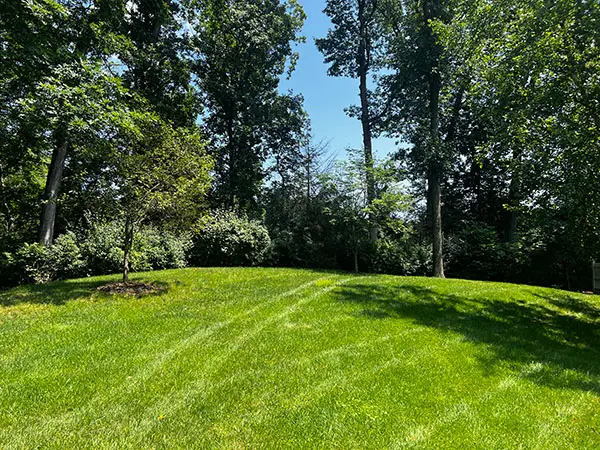
Short Answer: Most Hampton Roads lawns are one of five grass types: tall fescue (cool-season, the most common across our service area), Bermuda (warm-season, loves full sun), zoysia (warm-season, dense and slow-growing), centipede (warm-season, low-maintenance and lighter green), or St. Augustine (warm-season, broad blades, shade tolerant). Each one wants a different mowing height, a different fertilization calendar, and different weed control products. Identifying what you actually have is the single most useful thing you can do for your lawn this spring.
We get a version of this question almost every week. A homeowner in Smithfield or Suffolk or Chesapeake calls us and says, “I have no idea what kind of grass I have. The previous owner never mentioned it, and honestly, it all just looks like grass to me.” That is totally fair. Grass identification is one of those things nobody teaches you when you buy a house, and the difference between species can be subtle until you know what to look for.
Here is why it matters. The fertilizer schedule, mowing height, watering routine, and weed control products that make a Bermuda lawn thrive will actively damage a fescue lawn (and vice versa). Putting the wrong pre-emergent down at the wrong time can wipe out grass you were trying to protect. So before you spend another dollar on lawn care, let us walk you through how to figure out what you have growing in your yard.
The Five Grass Types You Will Find in Hampton Roads
Hampton Roads sits in what turf scientists call the transition zone, which is the band of the country where neither cool-season nor warm-season grasses are obviously the right choice. That is why our region has more variety than most. Drive through one neighborhood in Carrollton and you will see fescue, Bermuda, and zoysia all on the same block. Here is what each one looks like and what it wants from you.
Tall Fescue: The Most Common Lawn in Our Service Area
Tall fescue is a cool-season bunch-type grass that stays green through most of the year in Hampton Roads, including winter when warm-season grasses go brown. The blades are medium to wide, with a slightly coarse texture and a dark green color. If you run your hand across the lawn and the blades feel a little rough rather than silky, that is usually fescue.
Fescue does not spread by runners the way Bermuda or zoysia do. Each plant grows as its own clump, which is why thin fescue lawns need overseeding every fall to fill back in. The roots can go deep when soil conditions are right, which helps the lawn survive Hampton Roads summers, but only if you mow it tall (3.5 to 4 inches) and water deeply rather than frequently.
What fescue needs from you: a fall-heavy fertilization calendar (most of the nitrogen goes down in September through November), overseeding every year or every other year, preventive fungicide treatments through the humid summer (brown patch will tear through a fescue lawn in a single July week), and a tall mowing height. Scalping fescue is one of the fastest ways to lose a lawn in our climate.
Bermuda: The Sun Lover
Bermuda grass is a warm-season grass that goes dormant (brown) from late October through April, then wakes up and grows aggressively from May through September. The blades are narrow, the texture is fine, and the color is a medium to slightly blue-green during active growth. Bermuda spreads by both above-ground runners (stolons) and below-ground runners (rhizomes), which is why it will creep into your flower beds if you let it.
The easy field test for Bermuda: in May, get down on your knees and look for thin runners spreading horizontally across the soil with small leaves coming off them at intervals. If you see them, you almost certainly have Bermuda or zoysia. Bermuda runners are thinner and the leaves are sparser. Bermuda also demands full sun. If your lawn is patchy under trees and full where the sun hits, that is a strong Bermuda signal.
What Bermuda needs from you: short mowing (1 to 2 inches with a reel mower, 1.5 to 2.5 inches with a rotary mower), heavy summer fertilization (nitrogen May through August), and aggressive pre-emergent in February and again in May to keep crabgrass and goosegrass at bay. Bermuda also benefits from annual core aeration because it builds a dense thatch layer that can choke the lawn over time.
Zoysia: The Dense, Slow-Growing Premium Option
Zoysia is the grass that often gets people stopping to ask, “What is that?” It forms a thick, carpet-like surface that feels almost springy underfoot. The blades are short and stiff, the color is a rich medium green, and the density is noticeably higher than Bermuda or fescue. Zoysia is also a warm-season grass, so it goes tan or straw-colored in winter, usually a little later in the fall than Bermuda and a little earlier in the spring.
Zoysia tolerates more shade than Bermuda but less than fescue or St. Augustine. It tolerates salt spray better than most grasses, which is one reason you see it on properties closer to the water in Poquoson and parts of Hampton. The downside is that it is slow to establish and slow to recover from damage, so a zoysia lawn that gets neglected can take years to bring back.
What zoysia needs from you: moderate mowing height (1.5 to 2.5 inches), lighter fertilization than Bermuda (zoysia can actually struggle with too much nitrogen), pre-emergent timing similar to Bermuda, and patience. Zoysia rewards consistent care over many seasons rather than aggressive intervention.
Centipede: The Low-Maintenance Choice
Centipede is less common in our area than the others, but we do see it, particularly on older properties and on sandy soils closer to the water. The color is a noticeably lighter, almost apple-green, and the texture is medium. Centipede spreads by stolons only (no underground rhizomes), and the runners look a bit like a centipede crawling across the soil, which is where the name comes from.
Centipede is the “do less, get more” grass. It actually thrives in lower-fertility soil and resents heavy fertilization. Too much nitrogen will cause a condition called centipede decline, where the lawn yellows, thins, and eventually fails. If you have inherited a centipede lawn and have been hammering it with fertilizer thinking that is what good lawns need, please call us before you do another round.
What centipede needs from you: low and slow fertilization (one to two light feedings per year), mowing at 1.5 to 2 inches, slightly acidic soil, and protection from iron deficiency, which shows up as yellowing in summer. Centipede also does not tolerate heavy traffic or heavy thatch, so light annual dethatching can help.
St. Augustine: The Broad-Bladed Shade Tolerator
St. Augustine is the grass with blades wide enough that you can clearly see one from another at standing height. The color is a deep blue-green, the texture is coarse, and the stolons are thick and prominent above the soil. It tolerates more shade than any other warm-season grass we work with, which is why you see it on properties with mature tree cover.
The catch is that St. Augustine is more sensitive to cold than the other warm-season options, and winters along the cooler northern edge of our service area can occasionally damage it. It also does not tolerate heavy traffic, and it is susceptible to chinch bug damage, which can take out a section of lawn in weeks if you do not catch it.
What St. Augustine needs from you: high mowing (3 to 4 inches), regular fertilization through the warm months, careful pre-emergent product selection (some products that are safe on Bermuda will damage St. Augustine), and proactive monitoring for chinch bugs and gray leaf spot. If your lawn has St. Augustine, you want a provider who knows the difference between herbicides that are labeled for it and herbicides that are not.
What to Do If You Still Are Not Sure
If you have read through all of that and still cannot say with confidence what is growing in your yard, that is completely normal. Honestly, a lot of Hampton Roads lawns are a mix, with fescue dominating the shadier zones, Bermuda taking over the sunny patches, and something else creeping in along the edges. Reading a mixed lawn takes a trained eye.
When we visit a new property, the first thing we do is walk the lawn and identify every grass species present. We also collect a soil sample, check the soil pH, look at thatch depth, and note any disease pressure. All of that goes into a written care plan that is built for what you actually have, not for what a generic program assumes you have.
If you would like us to come out and identify your grass type for you, call (757) 238-8901 or visit stg-5eq9zo.elementor.cloud/request-a-quote. There is no charge for the visit, and you will leave the conversation knowing exactly what you are working with and what your lawn needs to look its best this season. With five Virginia Tech Certified Turfgrass Professionals on our team and 17+ years working coastal Virginia soils, identifying grass is one of the things we do every single day.
Knowing what you have is half the battle. The rest is just doing the right things in the right order at the right time.