
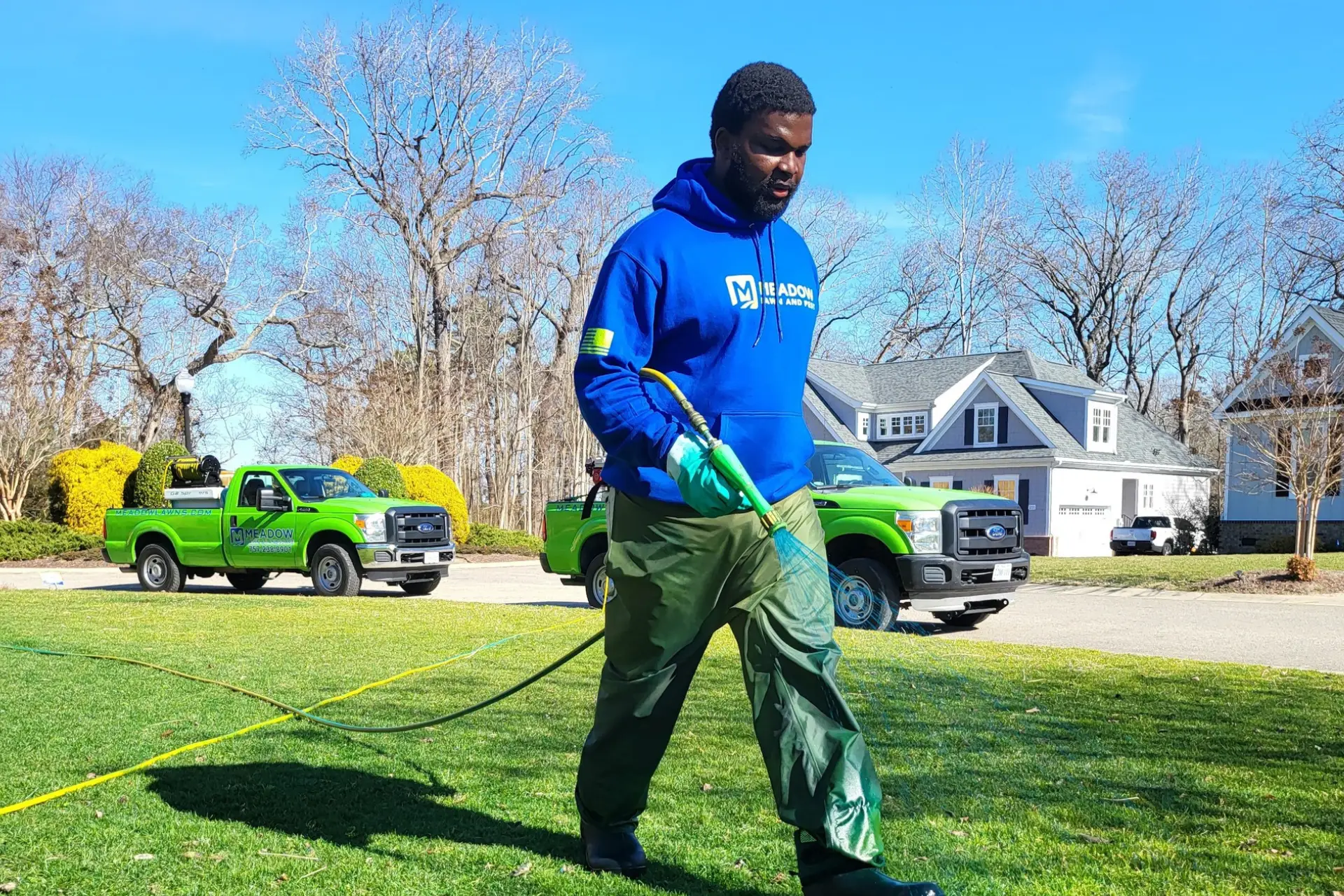
Short Answer: If crabgrass has already broken through your lawn in May, the pre-emergent window for this season is closed. Your remaining options are selective post-emergent herbicides (quinclorac for fescue lawns, fenoxaprop or mesotrione depending on grass type), spot treatments for isolated patches, and an honest commitment to a stronger pre-emergent program next February through early April. Catch it small, treat at the right air temperature, do not mow within two days of application, and water lightly afterward. Most homeowners can get usable control if they start treating before the plants tiller out.
Every May, our phones start ringing with the same question. “I am seeing these wide, light-green clumps in the lawn that look almost like grass but spread out flat. Is that crabgrass, and is it too late to do anything about it?”
The answer is usually yes, that is crabgrass, and no, it is not too late. But the playbook is different now than it was eight weeks ago. The pre-emergent barrier we put down in February and again in early April is what prevents crabgrass seed from germinating in the first place. Once the plants are up and growing, pre-emergent does nothing. You have to switch to post-emergent strategies, which are more selective, more weather-dependent, and more expensive to do right. Here is how we think through it on Hampton Roads lawns.
How to Be Sure It Is Crabgrass and Not Something Else
The clumps you are seeing in May could be one of several things, and the treatment differs based on which one. Crabgrass has a few specific features that make it identifiable once you know what to look for.
The blades come off a central crown in a star pattern, almost flat to the ground. The color is a noticeably lighter, more yellow-green than your turf. As the plant matures it sends out runners with their own crowns, which is how a small patch becomes a giant one in a few weeks. The seed heads, when they appear in mid to late summer, look like fingers spreading out from a single stalk.
What people often confuse with crabgrass: dallisgrass (taller, with rougher seed heads, much harder to control and a year-round issue), goosegrass (similar growth pattern but darker, with a whitish center), nutsedge (triangular stem, brighter yellow-green, totally different chemistry needed), and Bermuda creeping into a fescue lawn. If you are not sure, snap a photo and text it to us at 757-238-8901 before you spray anything. The product that kills crabgrass will not touch nutsedge, and vice versa.
Why the May Crabgrass Pressure Is So Heavy in Hampton Roads
Crabgrass seed germinates when soil temperatures hit roughly 55 degrees at a 4-inch depth and stay there for several consecutive days. In coastal Virginia, that typically happens in the first half of April. Once temperatures climb into the 60s and 70s, germination accelerates. By the first week of May, the first wave of crabgrass is already up, tillering, and visible.
Our region has a few factors that make crabgrass pressure heavier than average. The sandy soils along the rivers and creeks warm up earlier than inland clay, which means germination starts sooner. Our long mowing season gives crabgrass more time to establish and produce seed. And the freeze-thaw cycles we get through March can disturb the pre-emergent barrier in spots, leaving germination windows that homeowners never see coming.
That is why timing the pre-emergent properly matters so much. A single application in March is not enough for Hampton Roads. Our program puts down a split application, one in February and a second in early April, specifically to keep the chemical barrier intact through the entire germination window. When customers skip the February round to save money, May is when they find out why we recommend both.
Your Post-Emergent Options (and How to Pick the Right One)
Once crabgrass is up, you have a few product families to choose from. The right one depends on your grass type, how mature the crabgrass is, and the air temperature on the day you apply.
Quinclorac is the workhorse for fescue lawns. It controls crabgrass at multiple growth stages and is safe on tall fescue, Kentucky bluegrass, and most cool-season turf. It works best on young plants (one to three tillers) and gets progressively less effective as the crabgrass matures. We typically tank-mix it with methylated seed oil to improve uptake. Quinclorac is not safe on St. Augustine, so if you have that grass type, you need a different approach.
Fenoxaprop-ethyl is another effective option, particularly on more mature crabgrass plants, and it is safe on fescue and most warm-season grasses except Bermuda, which it can damage. Read the label carefully if you are going to try this one yourself, because the grass-type restrictions are strict.
Mesotrione is a newer chemistry that works through a different mechanism, causing the crabgrass to bleach white and then die over a couple weeks. It is safe on many grass types and is useful when you have a mixed weed problem. The visual results take longer, which can be frustrating, but the control on young crabgrass is excellent.
For Bermuda and zoysia lawns, MSMA used to be the standard answer, but it has been heavily restricted, and we now lean on Drive XLR8 (the commercial form of quinclorac) or other selective options. The chemistry on warm-season grasses is more complicated, and the wrong product will turn your lawn yellow for weeks.
Timing the Application Right
Air temperature matters more than most homeowners realize. Most post-emergent crabgrass herbicides work best between 60 and 85 degrees. Below 60, the plant is not actively growing and will not absorb the product well. Above 85, the herbicide can volatilize and either fail to work or damage your turf.
In Hampton Roads, that means early to mid-May mornings are usually your best window, before the afternoon heat builds. If we are looking at a stretch of 90-plus degree days, we wait for a cooler week or apply at first light. Humidity and wind also matter. Spraying during a 15-mile-per-hour wind in coastal Virginia is how you end up with dead spots in your neighbor’s yard and a phone call you do not want.
Do not mow for at least two days before or after application. The crabgrass needs leaf surface area to absorb the herbicide, and mowing right before or after the spray dramatically reduces the result. Light irrigation 24 to 48 hours after application can help, but heavy irrigation right away washes the product off.
What to Do If Crabgrass Has Already Taken Over
If you are looking at a lawn that is more crabgrass than turf, post-emergent alone is not going to fix it. The herbicide will kill the crabgrass, but you will be left with bare soil where it used to be, and that bare soil is going to grow more crabgrass in a few weeks unless something else fills the space.
The honest path forward in that situation is a multi-step plan: knock down the crabgrass with post-emergent in May or June, keep the lawn watered and mowed properly through the summer to encourage whatever desirable turf is still present to fill in, and then aerate and overseed aggressively in early September (for fescue) or interseed Bermuda or zoysia in early summer (for warm-season lawns). Without that follow-through, you are spraying every year for a problem the lawn is going to re-create.
A lot of homeowners try the “spray and wait” approach and call us in August when the lawn looks worse than before. The repair work in that case usually costs more than what proper treatment and overseeding would have cost from the start.
Preventing This From Happening Again Next Year
The best post-emergent program is the one you do not need. If you put us on your lawn for a full 7-round program, the February and early-April pre-emergent rounds are designed to prevent the call you are making in May. We use products with longer residual activity than the bag-store options, and we time the applications based on soil temperature monitoring, not the calendar.
A few things you can do to support that program: do not core aerate in early spring (it breaks the pre-emergent barrier), keep your mowing height in the proper range for your grass type, water deeply but infrequently to encourage deep turf roots, and let us know right away if you see any crabgrass breaking through so we can adjust the program for your specific property.
What to Do Next
If you have crabgrass in your lawn right now, the worst thing you can do is wait. Every week you delay, the plants get bigger, more tolerant to herbicide, and closer to producing seed for next year. Call (757) 238-8901 or visit stg-5eq9zo.elementor.cloud/request-a-quote and we will come out, identify what you are dealing with, and put together a plan that handles this season's problem and prevents next season's.
With five Virginia Tech Certified Turfgrass Professionals on staff and 17+ years working coastal Virginia lawns, we know which products work in our specific conditions, which ones are safe on your specific grass, and how to time the application so you get control instead of a yellow lawn. The right move now saves you a lot of money and a lot of frustration through July and August.