
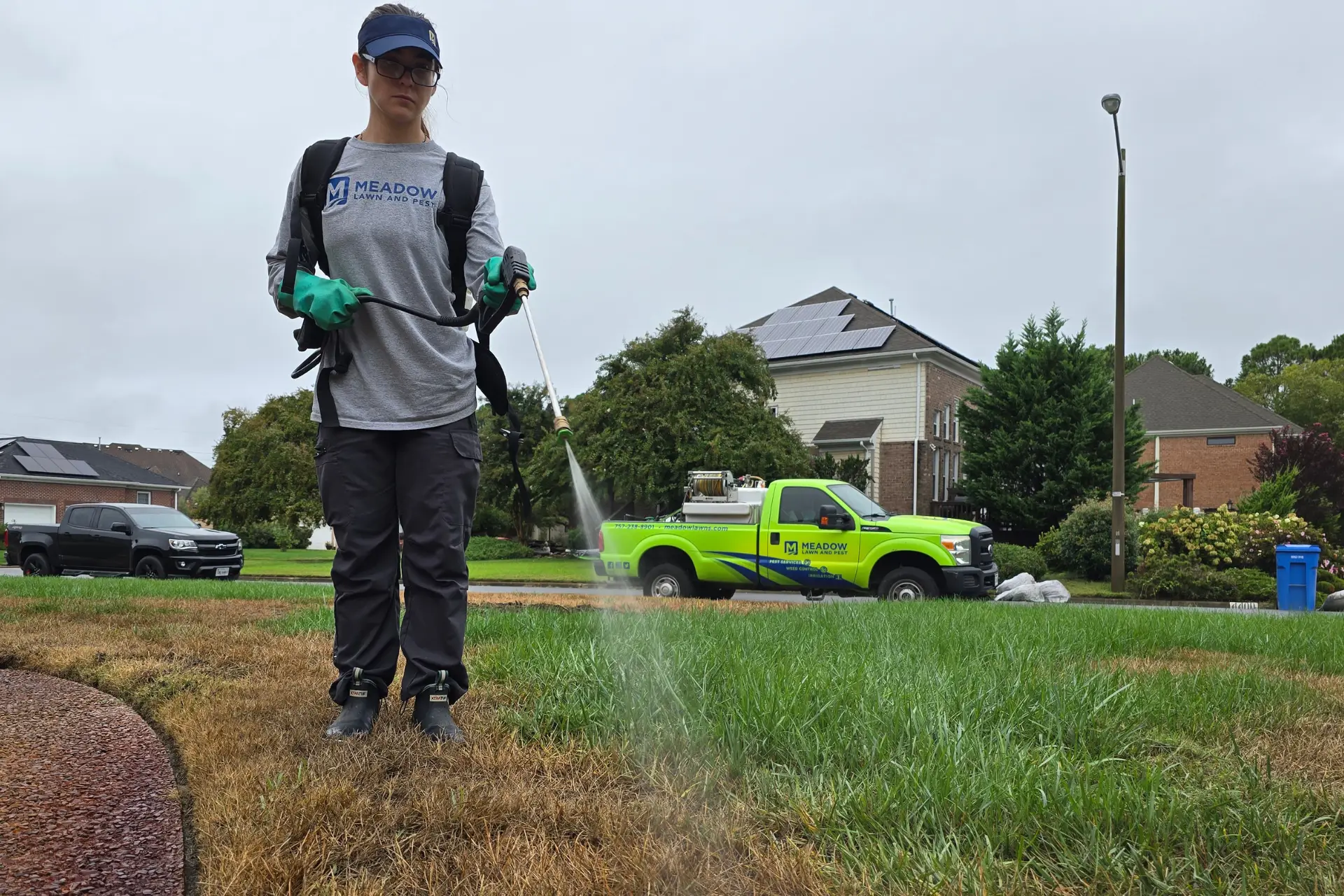
Short Answer: Brown patch is a fungal disease that thrives in Hampton Roads’ hot, humid summers, and it is the single most common reason a beautiful spring fescue lawn falls apart in July and August. You will see it as circular tan or brown patches with darker borders, often appearing first in low spots, shaded areas, and anywhere the lawn stays damp at night. The good news: it is preventable with timely fungicide applications starting in late May, and it is treatable if caught early. Waiting until the damage is obvious means you are already in recovery mode. Here is how to spot it, treat it, and most importantly, prevent it.
You spent April and May doing everything right. You held off on watering until the lawn told you it needed it. You mowed at the proper height. You let your fertilization program build a thick, deep green stand of fescue. The yard looked like a magazine cover Memorial Day weekend.
Then you went out on a Saturday morning in mid-July, coffee in hand, and noticed something that was not there last week. A circle of tan grass in the middle of the lawn, maybe a foot across. By the next weekend it is two feet. By the end of the month, several patches have merged into one ugly, irregular dead zone right where you set up the patio chairs.
If this story sounds familiar, you have met brown patch. And if you live in Hampton Roads, you are going to keep meeting it every summer until you decide to do something about it.
What Is Actually Happening to Your Lawn
Brown patch is caused by a fungus called Rhizoctonia solani. The fungus lives in your soil and thatch all year round, mostly dormant. When summer conditions hit a specific combination, it activates and starts attacking grass blades and crowns.
The trigger is roughly this: nighttime temperatures consistently above 65 degrees, humidity above 80 percent for extended periods, and lawn surfaces that stay damp at night (from dew, irrigation, or rain). In Hampton Roads, that combination shows up reliably from late June through early September. Some years it starts in early June. Some years it pushes into mid-September. But it shows up.
The fungus spreads outward from infection points in concentric rings, which is why brown patch tends to look like circles or arcs. As individual grass plants die from the inside out, you see tan or straw-colored grass with darker, sometimes purplish borders where the fungus is actively attacking new tissue. In severe cases, you can see white or gray fungal mycelium on the grass blades in the early morning, before the dew burns off.
The damage happens fast. A patch that is barely visible Tuesday can be obvious by Friday. And once the fungus has killed a section of fescue, the recovery requires reseeding, because dead plants do not come back.
Why Hampton Roads Is Brown Patch Heaven
If you talk to a turf professional in Phoenix or Denver, brown patch is barely on their radar. In Hampton Roads, it is the defining summer challenge for fescue lawns. A few things make our region unusually hospitable to fungal disease.
Our humidity is relentless. From June through September, dewpoints regularly run in the 70s, which means the air is saturated and grass surfaces stay wet for hours overnight. The fungus needs that surface moisture to spread. Drier climates simply do not provide it for long enough stretches.
Our nighttime lows do not drop. Many summer nights in Hampton Roads bottom out in the upper 70s, which keeps both temperature and humidity in the disease activation zone for the full overnight period. In cooler climates, the temperature dips often break the cycle.
Our grass type works against us. Tall fescue is the dominant cool-season grass across coastal Virginia, but it is at the southern edge of where fescue can thrive. Our summer conditions push it past comfortable into stressed, and stressed grass is dramatically more susceptible to fungal infection than healthy, vigorous grass.
Our soil composition holds moisture. The clay soils common across much of Hampton Roads drain slowly, which keeps the root zone damp longer than a sandy soil would. That benefits the fungus.
Add it all up and you have an environment where brown patch is not a question of “if” but of “how bad” and “when.”
How to Identify Brown Patch (vs. Other Things That Look Similar)
Several things can cause patches of dead or dying grass, and they need different treatments. Here is how to tell them apart.
Brown patch produces roughly circular patches that grow over days to weeks, often with a smoke-ring or darker border at the leading edge. The grass blades themselves show tan lesions with darker margins. Mycelium may be visible on early morning blades before dew dries.
Drought stress shows up across high spots, slopes, and areas farthest from sprinkler heads, not as discrete circles. The grass turns straw-colored uniformly across the affected area, and it returns to green within 24 to 48 hours of deep watering. Brown patch does not bounce back from watering.
Grub damage produces irregular dead patches that pull up easily like a loose carpet, exposing white C-shaped grubs in the soil underneath. You can usually peel back affected turf and see the damage to the root system directly.
Fertilizer burn shows up as straight lines or geometric patterns matching where the spreader was pushed, especially overlap zones, and it appears within a day or two of application. Brown patch develops randomly across the lawn based on moisture and microclimate, not based on application patterns.
Pythium blight (less common but more aggressive) produces greasy, dark, sunken patches that spread very rapidly, often with a cottony white mycelium that is more obvious than brown patch’s. Pythium is essentially the worse cousin of brown patch and often follows heavy rainstorms with hot, humid conditions.
If you are not sure what you are looking at, take a clear photo of the patch in the morning before dew burns off, then call us. We can usually identify the issue from a good photo and tell you what to do next.
What Actually Works to Stop Brown Patch
The treatments that work fall into two categories: cultural practices that reduce the conditions the fungus needs, and fungicide applications that interrupt the disease itself. The most successful approach combines both.
On the cultural side, the highest-leverage changes are around watering and mowing. Water deeply and infrequently, and only in the early morning so blades dry by mid-day. Never water in the evening, which leaves the lawn damp through the entire fungus-friendly overnight window. Raise your mowing height to 3.5 or 4 inches in summer to shade the soil and reduce stress on the grass crowns. Avoid heavy nitrogen applications during summer heat, since lush, succulent growth is the most disease-prone. Improve airflow over the lawn by trimming back dense plantings that block evening breezes.
On the fungicide side, the key word is preventive. By the time you can see brown patch damage, the fungus has already been active for days, and curative treatments only stop further spread. They do not bring dead grass back. The lawns that come through summer cleanest are the ones treated with rotating preventive fungicides starting in late May or early June, before disease pressure peaks. Properly timed applications protect the lawn during the entire high-pressure window, typically four to six weeks of coverage per application depending on the product.
This is where professional treatment is significantly more effective than DIY. The fungicides that actually work in our climate are not the ones available at the big box store. Commercial products with rotating active ingredients (so the fungus does not develop resistance) are restricted-use and require licensing to purchase and apply.
The DIY Mistakes We See Every Summer
A few common patterns when homeowners try to handle brown patch on their own.
Watering more in response to the dead patches. The lawn looks thirsty, so the instinct is to water. But more water is exactly what the fungus needs. We see this turn a manageable infection into a yard-wide problem within two weeks.
Applying nitrogen to “green up” the brown areas. Nitrogen pushes succulent new growth that is even more susceptible to infection. The brown spots stay brown, the surrounding lawn becomes more vulnerable, and the problem expands.
Reaching for store-bought fungicide once damage is already visible. Most consumer-grade fungicides are formulated for tomatoes and roses, not turf. The few turf products available off the shelf typically use older active ingredients with weaker efficacy and shorter residual times. By the time the homeowner has applied two or three rounds with no improvement, the damage is severe.
Reseeding into infected turf in August. Even if you patch the dead spots, reseeding into a lawn with active fungal pressure usually means losing the new seedlings to the same disease. Reseeding work belongs in the fall, after disease pressure subsides and during the optimal cool-season seeding window.
Preventive vs. Reactive: The Difference in Real Numbers
Here is the math that drives most of our customers toward preventive fungicide programs once they have lived through a bad brown patch summer.
Preventive fungicide for an average Hampton Roads property over the brown patch season typically runs $300 to $500 across two or three properly timed applications. The lawn comes through summer largely unaffected, going into fall ready for normal aeration, overseeding, and recovery work as part of routine fall renovation.
Reactive treatment after brown patch establishes typically requires more aggressive (and more expensive) fungicide applications to slow the spread, plus reseeding and renovation work in fall to repair the damage. Total recovery cost often runs $800 to $1,500+, and the lawn does not look right until the following spring at the earliest.
Doing nothing is also an option. The lawn will recover some over fall and winter as the fungus goes dormant and surviving fescue spreads back into bare areas. But it usually means a thinner, weedier, less healthy lawn going into the next year, which leaves it more vulnerable to next year’s brown patch cycle. Some homeowners go through this cycle five or six years in a row before they decide to break it.
What to Do Next
If your fescue lawn fell apart last summer and you do not want a repeat, now is the time to plan. Brown patch prevention starts in late May, which means putting a program in place in April or early May, before the conditions trigger the fungus.
If you would like our help, call us at (757) 238-8901 or visit stg-5eq9zo.elementor.cloud/request-a-quote. We will assess your lawn, identify any disease pressure already present, and put together a fungicide program timed for your specific property and grass type. Most of our preventive customers add the program as an upgrade to their existing 7-round fertilization plan, which keeps the whole lawn working as one system rather than fighting against itself.
With 17+ years caring for Hampton Roads fescue lawns and five Virginia Tech Certified Turfgrass Professionals on staff, we have seen every variation of brown patch our climate produces. We know what works, what does not, and how to keep your lawn looking the way it did Memorial Day weekend straight through Labor Day.
We proudly serve Carrollton, Smithfield, Windsor, Suffolk, Chesapeake, Hampton, Newport News, Poquoson, York County, and the surrounding Hampton Roads area. The lawn you built this spring deserves to make it through the summer.