Cool Season Lawn Fertilization Weed Control in Suffolk
Expert Cool Season Lawn Care for Suffolk Properties
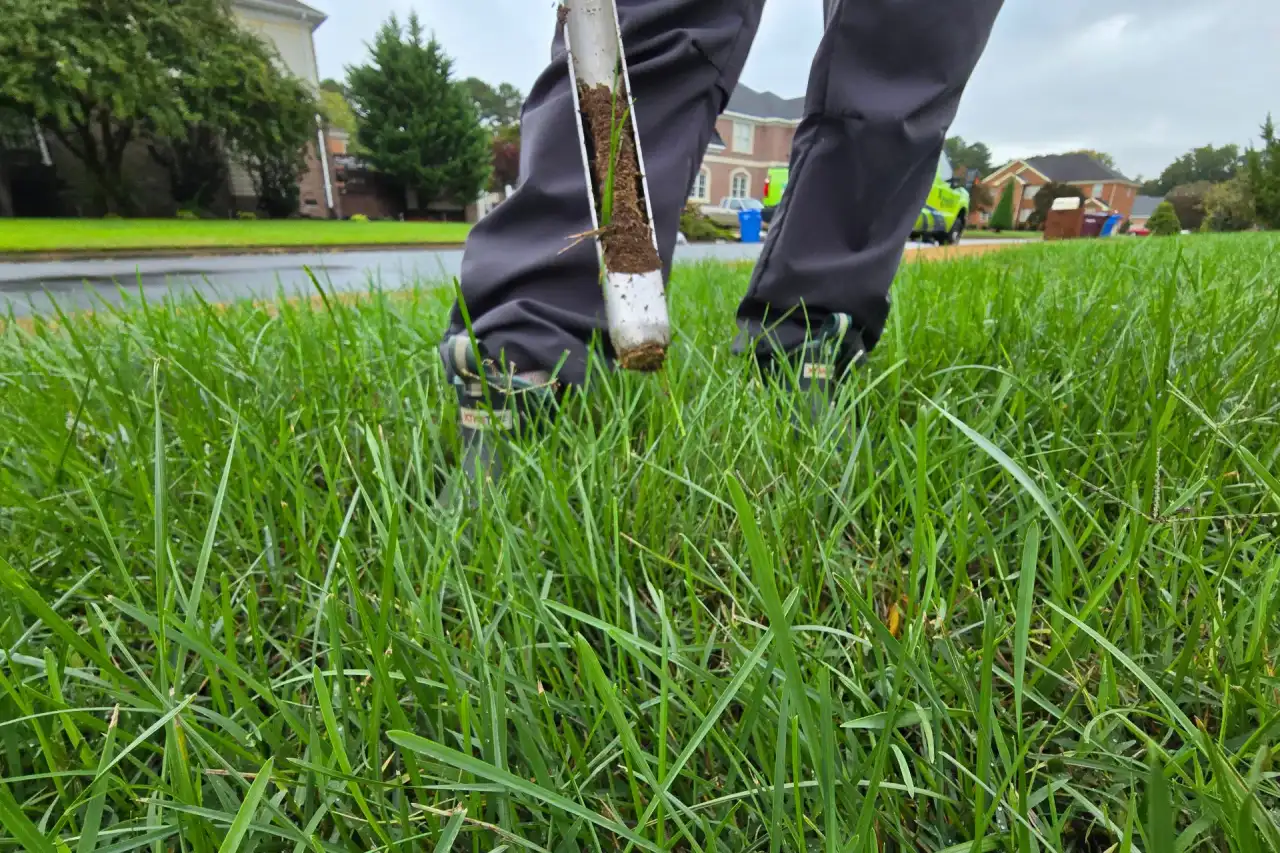
Suffolk is one of the largest cities in Virginia by land area, with everything from tight suburban streets near downtown to multi-acre rural properties out toward the county line. That range produces a wide variation in soil type, moisture, and sun exposure — no two Suffolk yards start from the same place. Tall fescue and fine fescue can deliver outstanding results across Suffolk when they are supported by a 7-round year-round fertilization and weed control program. Our team runs a free soil test and inspection up front so every application is customized to your pH, nutrient levels, and weed pressure rather than based on a one-size template. Timing is driven by observed soil temperature — not by a date on a calendar.
Best Cool Season Grasses for Suffolk Lawns
Tall fescue is the dominant cool season grass planted across Suffolk, and for good reason — it handles the heat, clay soil, and occasional drought of this region better than most alternatives. Its root system grows deeper than many other cool season grasses, which improves drought tolerance when summer slows active growth. Fine fescue is the right choice for the shadier spots under Suffolk’s mature trees. Both grow most vigorously when soil temperatures fall between 50 and 65°F — primarily fall and early spring, which is where our 7-round program focuses its most active feeding and weed-control rounds. Identifying your variety is part of the free initial inspection before Round 1.
Fertilization Timing for Suffolk's Cool Season Turf
The most productive fertilization windows for Suffolk lawns are fall from September through November and early spring from late February through April. These are the periods when cool season grass roots efficiently draw up nutrients. Our 7-round program aligns each application with those cycles — Round 1 in late January / February to jump-start spring, Rounds 2 and 3 through peak spring growth, Rounds 4 and 5 with a 5-0-30 slow-release blend through summer heat to support roots instead of top growth, and Rounds 6 and 7 in the fall and early winter to build energy reserves. Timing is driven by observed soil temperature conditions, not by a fixed calendar.
Pre-Emergent Weed Control Across Suffolk
Suffolk’s larger properties and varied terrain give weed seeds many opportunities to establish, which is why pre-emergent weed control is a cornerstone of our 7-round program here. We apply Prodiamine in Round 1 (late January / February) and again in Round 2 (March / April) to keep a continuous barrier in place through the critical spring germination window — Prodiamine provides roughly 6–8 weeks of control per application, so two overlapping applications cover the full spring risk. Target weeds include crabgrass, foxtail, and other summer annuals. A fall pre-emergent targets winter annuals like annual bluegrass and chickweed. Timing is driven by soil temperature rather than a fixed calendar date, which is how we hit the window consistently each year.
Controlling Established Weeds in Suffolk Lawns
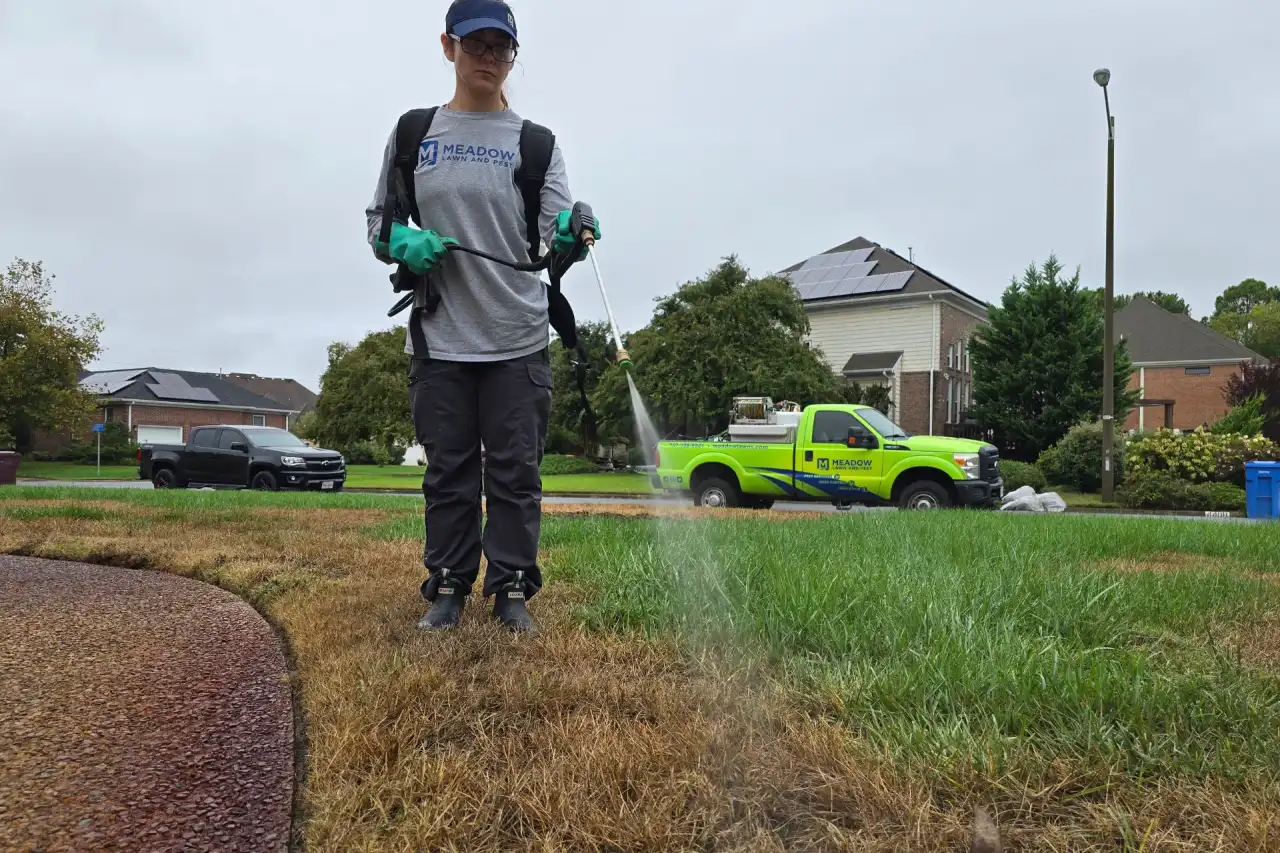
Where weeds are already established in a Suffolk lawn, post-emergent herbicides remove them without damaging the surrounding grass when applied correctly. Selective broadleaf herbicides target dandelion, broadleaf plantain, clover, thistle, and wild violet while leaving fescue unaffected. Crabgrass that escapes the Prodiamine barrier can be treated with a post-emergent in early summer before it drops seed. Most broadleaf weeds show visible decline within 7–14 days of a correctly applied treatment when temperatures sit between 55 and 85°F — the range where post-emergents actually work. Some stubborn species take the full 21 days, which is why our re-treatment policy waits 21 days before a complimentary spot re-service. Nutsedge and dallisgrass require specialty chemistry quoted separately.
Get A Quote
Ready to get started? Fill out the form or contact us at the phone number below to get started.
Weeds Commonly Seen in Suffolk Lawns
Suffolk lawns face weed pressure from a wide range of sources given the city’s size and mix of suburban, rural, and transitional landscapes. Crabgrass is the dominant summer annual, filling thin areas rapidly once temperatures rise in June and July. Nutsedge is a challenge wherever drainage is poor or irrigation runs too long — and it requires specialty chemistry quoted separately from the 7-round program. Wild violet spreads in shaded areas and resists many standard broadleaf programs. Thistle invades along fencelines and in lawns with thin, open turf. Plantain thrives in compacted areas with heavy foot traffic. Clover flourishes in low-nitrogen lawns. Annual bluegrass and henbit emerge in fall and winter. The combination of Prodiamine pre-emergent and targeted post-emergent applications applied consistently is the most effective long-term strategy.
Fall Lawn Treatments for Suffolk Properties
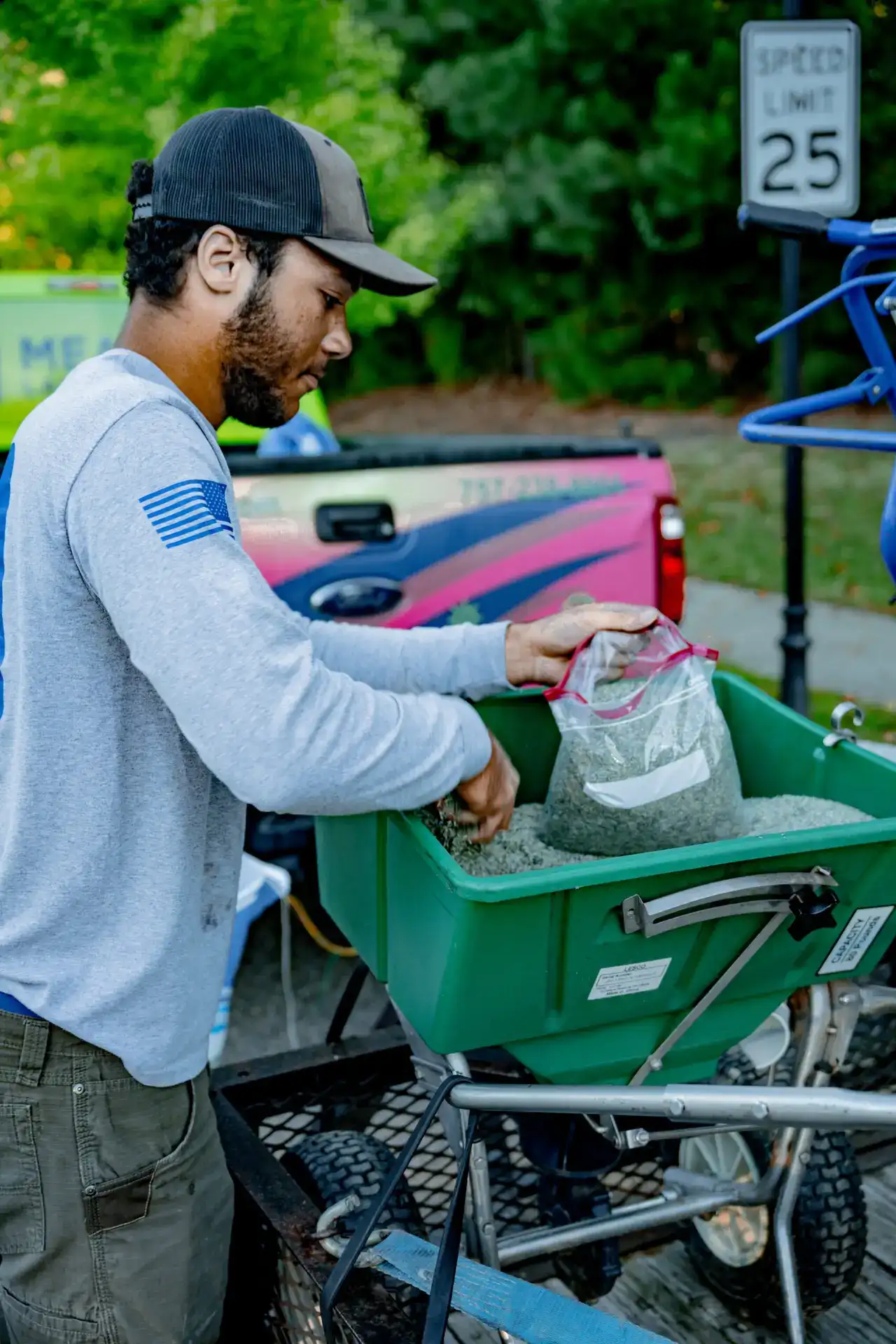
Fall is the most valuable season for lawn investment in Suffolk. Cool season grasses grow most actively from September through November, building the root mass and nutritional reserves that carry the lawn through winter and fuel spring green-up. Round 6 of our 7-round program (October–November) uses 32-0-15 slow-release fertilizer to promote root development and winter hardiness; it is timed after aeration / overseeding and skips herbicide so newly seeded areas are protected (herbicide can be added in Round 6 on request if you’re not overseeding). Round 7 in November / December adds nitrogen plus a post-emergent to eliminate winter annual weeds. On larger Suffolk properties with thin or bare areas, early-fall overseeding is the ideal window for tall fescue establishment. Fall investment delivers visible results the following spring.
Spring Lawn Treatments for Suffolk Cool Season Turf
In Suffolk, spring lawn care focuses on recovering from winter, preventing warm-season weed germination, and fueling the cool season growth flush. Round 1 (late January / February) pairs nitrogen with Prodiamine pre-emergent and post-emergent herbicides for active winter weeds. Round 2 (March / April) adds a second nitrogen application plus a second Prodiamine pre-emergent for continuous coverage through the critical crabgrass germination window. Round 3 (late April / May) uses slow-release nitrogen with iron for deep green color and potassium for stress tolerance, plus spot treatment for any breakthrough weeds. Bare spots from winter are best addressed in early fall rather than spring, as spring-seeded areas often struggle before summer heat arrives. Spring treatments set the entire growing season trajectory.
Soil Conditions on Suffolk Lawns
Suffolk sits on a range of soil types that vary across the city. Properties closer to the Nansemond River tend to have sandier, well-drained soils. Many suburban neighborhoods have heavier clay-loam soils that drain slowly and compact under foot traffic and equipment. Rural properties may show soil variation within a single lawn depending on the land’s history and use. Soil pH is a commonly overlooked factor — when pH drifts below 6.0, nutrients become locked in the soil and unavailable to grass even when fertilizer has been applied. Every Suffolk lawn enrolled in the 7-round program starts with a free soil test that checks pH, N-P-K, organic matter, and micronutrients, with written results reviewed before treatments begin. Lime applications can correct acidic pH over one to two seasons.
Responsible Lawn Treatments for Suffolk Properties
Suffolk properties come in all shapes and sizes, from small suburban lots to expansive rural lawns, and our product safety standards apply consistently to all of them. Every herbicide and fertilizer we use is EPA-registered and applied at rates that follow label requirements — federal law under FIFRA, “the Label is the Law.” For liquid applications, people and pets should stay off treated areas until dry (typically 1–2 hours). Granular fertilizer is safe once watered in. We follow strict weather restrictions: no applications with winds over 15 mph, within 2 hours of forecast rain, above 90°F, or below 32°F for post-emergents. On larger Suffolk properties we are especially mindful of buffer zones near waterways and pond edges. Documentation and safety data sheets are available on request.