
Complete Home Pest Control
What Complete Home Pest Control Actually Covers
Meadow Lawn & Pest • October 2026 • Carrollton & Hampton Roads, VA • 7 min read
Short Answer: Complete home pest control should mean the full exterior envelope, not just a strip of ground along the foundation. That means the foundation band, entry points where utilities pass through walls, door and garage thresholds, eaves and soffits where spiders and wasps build, window frames, and the landscape immediately around the structure. Interior work is targeted rather than routine, addressing specific harborage areas when activity warrants. Termites, mosquitoes, and wildlife are normally separate services, which is the most common source of confusion.
Complete home pest control is a phrase that appears on nearly every pest company's website, and it describes meaningfully different scopes depending on who is saying it. Some companies mean a thorough treatment of the entire building envelope. Others mean a spray around the foundation and a wave from the truck.
Since you cannot tell from the phrase, here is what a thorough service actually covers, what falls outside it, and the questions that reveal which one you are being quoted.
The Exterior Is Where the Work Belongs
Most of what ends up inside a Hampton Roads home came from outside and crossed the building envelope to get there. That makes the exterior the efficient place to intervene, because it addresses the problem earlier in the sequence and keeps treatment out of your living space.
A proper exterior service starts with a treated band along the foundation, covering both the wall itself and a strip of ground adjacent to it. That is the route most crawling pests take, and it is the minimum anyone means by perimeter treatment.
Beyond that, the work follows the actual entry points. Where pipes, cables, dryer vents, and electrical conduit pass through the wall, there is a gap around them, and those gaps are the doors pests use. Door thresholds and garage openings get the same attention, since a garage is essentially a cave with a wide entrance.
Window frames and the seams where different materials meet round it out. Anywhere brick meets siding, a sill meets a foundation, or an addition joins the original structure, there is a seam, and seams are where the envelope is weakest.
Eaves and Soffits Matter More Than People Expect
This is the part most commonly skipped, and it is why some homeowners feel their service is not working even though the foundation gets treated faithfully.
Spiders build where flying insects gather, and flying insects gather near lights and under overhangs. That means eaves, soffits, porch ceilings, and the corners under a roofline are where webbing accumulates, and treating ground level does nothing about it.
Physically knocking down webbing is part of the job rather than a cosmetic extra. It removes what is there, and it also gives you a read on the next visit, since fresh webbing means continuing activity while clean eaves mean the problem is controlled.
Wasps and hornets build in the same protected overhangs, and under decks and in porch corners. Those nests are considerably easier to address before they are established than after.
In this region, carpenter bees deserve mention here too. They bore into fascia, trim, and any unpainted or weathered wood under an overhang, and the galleries they leave are used again the following year. Treating those galleries and the surrounding wood is part of a thorough exterior service on a home with wood trim.
The Landscape Right Around the House
Conditions matter as much as products, and a good technician should be paying attention to them.
Mulch piled against the foundation, shrubs touching siding, firewood stacked against the wall, and leaf litter along the foundation line all create sheltered routes leading directly to your house. They hold moisture, they block airflow, and they give pests cover from predators.
Pulling mulch back a few inches from the foundation and trimming shrubs off the siding reduces pressure meaningfully and costs nothing but an afternoon. A service that treats the perimeter every quarter and never mentions the ivy growing up the wall is treating a symptom.
Moisture is the companion issue and it matters a great deal in this region. Downspouts discharging at the foundation, gutters backing up, and low spots holding water all create the damp conditions that draw pests, and in coastal Virginia that combines with an already high water table.
Crawl spaces deserve specific attention here given how many Hampton Roads homes have them. A damp crawl space is a pest habitat, and it is where camel crickets, spiders, and rodents concentrate.
What Interior Service Actually Looks Like
Interior work is targeted rather than broadcast, and the modern version looks nothing like the fogging people imagine.
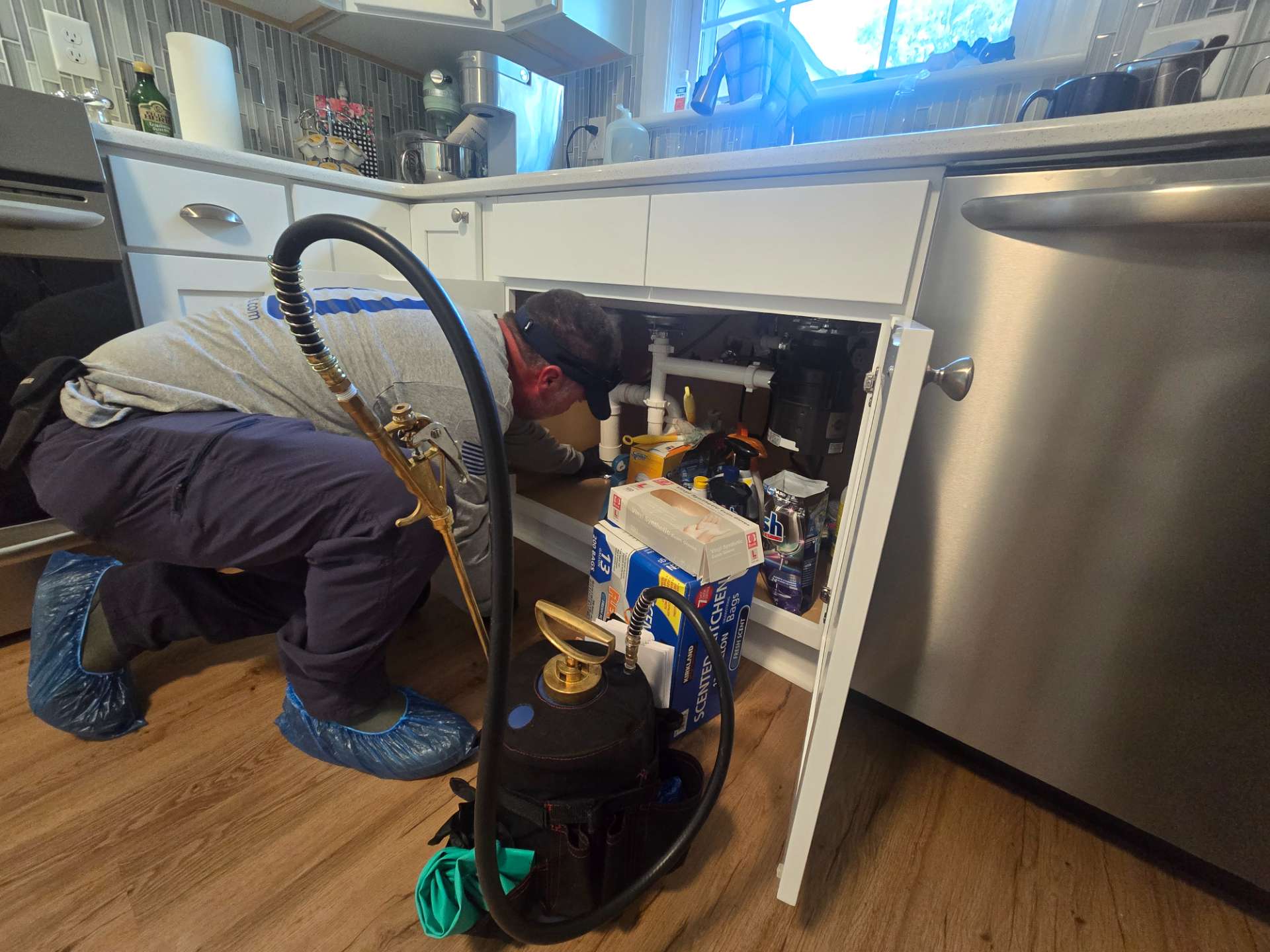
Pests do not use a room evenly. They travel along edges and harbor in dark undisturbed spaces, so the work happens under sinks where plumbing penetrates the wall, behind and beneath appliances, around water heaters, along baseboards in rooms with activity, and inside cabinet voids.
Garages, utility rooms, and storage areas get particular attention, because they stay undisturbed and connect most directly to the outdoors.
Monitoring devices are part of it. Placed where activity is suspected, they answer questions treatment cannot. Whether something is actually present, what it is, where it travels, and whether the response is working.
For most households, interior service is occasional rather than routine. If a company recommends interior treatment on every visit by default, that is worth a question. It is not automatically wrong, and it should be justified by something found rather than included by habit.
What Is Normally Not Included
This is where most billing surprises come from, so it is worth stating plainly.
Termites are almost always a separate service. That is not companies withholding something, it reflects genuinely different work involving different inspection, different products, and often a separate agreement with its own terms. In Tidewater Virginia, termite pressure is among the highest in the country, so this is a conversation to have deliberately rather than assume is handled.
Mosquito control is typically separate as well, since it involves different application methods targeting resting habitat rather than the building envelope.
Wildlife, meaning squirrels, raccoons, bats, and birds, is a different discipline requiring exclusion work and often different licensing.
Bed bugs are specialized and separate essentially everywhere. Wood destroying organisms beyond termites, including powderpost beetles and wood decay fungus, generally require their own inspection.
None of these being excluded is a problem. Not knowing they are excluded is.
Questions That Reveal the Scope
Five questions sort companies quickly, and any thorough operation answers them without hesitation.
Does the service include eaves, soffits, and webbing removal, or is it ground level only. Is interior treatment included when needed, or billed separately. What specifically is covered and what is excluded, in writing. What happens if pests appear between scheduled visits. And does the technician walk the property and report conducive conditions, or just apply and leave.
That last one matters more than it sounds. The gaps, moisture problems, and landscape conditions a technician notices are frequently worth more than the application itself, because fixing a condition prevents the problem rather than suppressing it. A service that reports nothing after four visits a year either has an unusually perfect property or is not looking.
Frequency and What It Buys
Most complete home programs run on a quarterly schedule, and the interval is not arbitrary.
Residual products break down with sunlight, rain, and irrigation, and in our heat and humidity that happens faster than in drier regions. A treated band is meaningfully effective for weeks rather than months, so quarterly roughly matches both the product life and the way pest pressure shifts through the seasons.
The visits also land at useful moments. A fall service addresses the invaders moving indoors, a spring service catches ants and the start of wasp activity, and summer covers peak general pressure. Scheduling to the season is more useful than an arbitrary date every ninety days.
What to Do Next
Walk your own foundation with a flashlight and look at it the way a mouse would. Check the garage door seal, the gaps where utilities enter, the dryer vent, and where siding meets the slab. Anything you can slide a pencil into is an entry point.
Look up at your eaves and overhangs for webbing, wasp nests, and the round holes in fascia or trim that indicate carpenter bee galleries. That tells you whether your current service is covering the upper envelope.
Pull mulch back from the foundation, trim shrubs off the siding, and move firewood away from the house. Those three reduce pressure every year rather than just this one.
Ask your current provider, or any you are considering, the five questions above and get the exclusions in writing.
To have someone walk the property and quote the full envelope rather than a strip of ground, call Meadow Lawn and Pest at 757-238-8901 or visit meadowlawnandpest.com. We serve Carrollton, Smithfield, Windsor, Suffolk, Chesapeake, Hampton, Newport News, Poquoson and York County.