
Irrigation Blowout
What Does an Irrigation Blowout Cost, and Can You Do It Yourself?
Meadow Lawn & Pest • October 2026 • Carrollton & Hampton Roads, VA • 7 min read
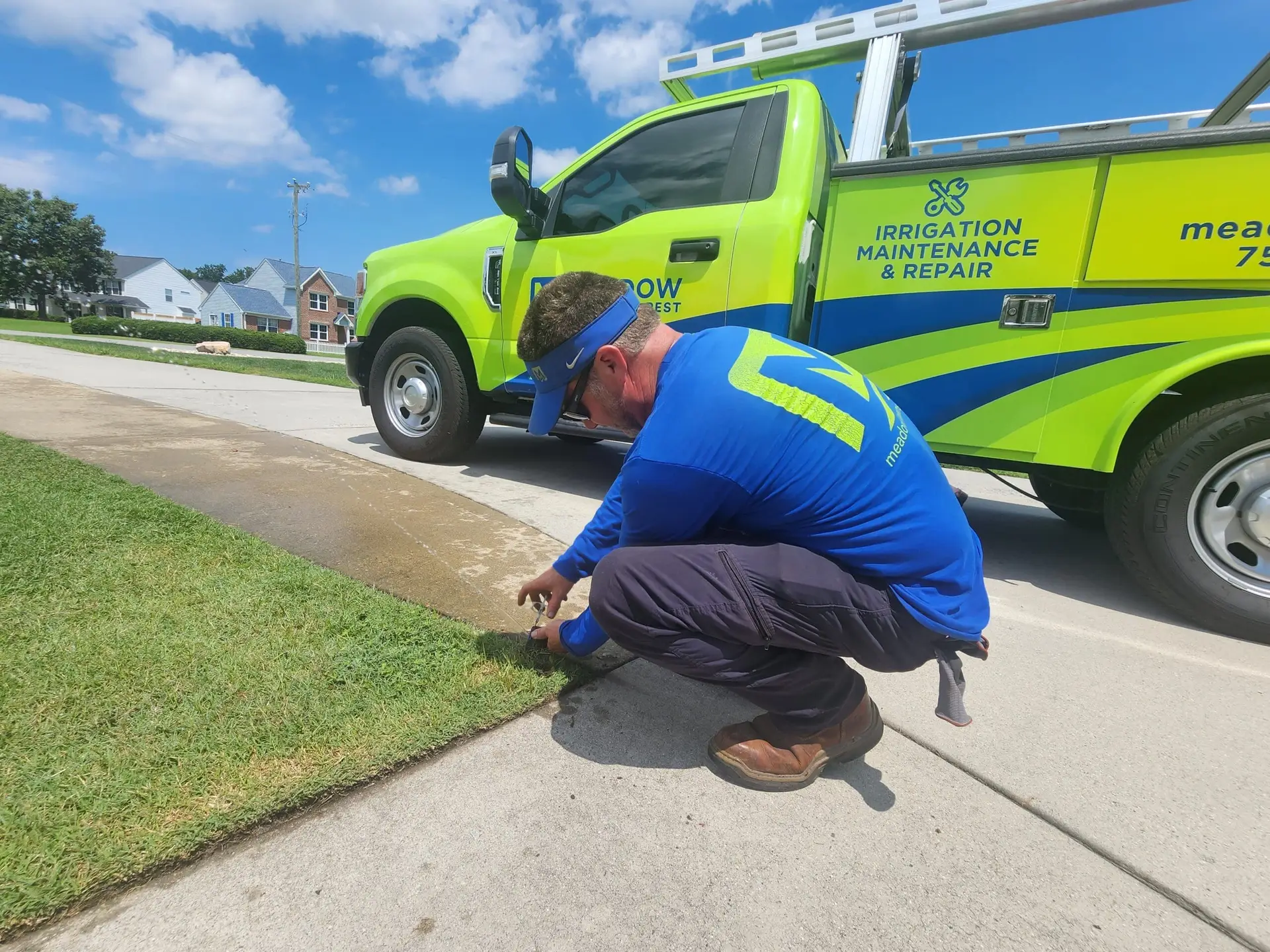
Short Answer: A professional blowout on a typical Hampton Roads residential system generally runs $75 to $175, with larger systems carrying more zones priced above that. Doing it yourself is possible and the obstacle is equipment rather than skill. The compressors most homeowners own deliver adequate pressure and nowhere near the airflow needed to push water through a zone, so the system looks blown out while lines stay wet. Renting adequate equipment costs enough that the savings against a professional visit are modest.
Winterization pricing is straightforward, and the more interesting question is whether to do it yourself. That one has a real answer rather than a sales answer, and it comes down to equipment rather than difficulty.
Here are the numbers for Hampton Roads, an honest look at the do it yourself version, and the specific reason the garage compressor does not work.
What It Costs
Most companies price winterization by zone count or with a flat rate covering a typical residential system.
Around our area, a standard residential blowout commonly runs $75 to $175. Systems with more zones, meaning larger properties or ones with extensive bed irrigation, run higher, and some companies price per zone above a base number.
That figure normally includes shutting down and isolating the backflow device, blowing out all zones, cycling them a second time, and shutting down the controller for the season.
Some companies bundle winterization with spring startup at a combined rate, which is frequently the better value if you intend to use a service for both. Spring startup involves recharging the system, checking every head, and adjusting coverage, and it is genuinely more labor than the blowout is.
Set against the cost of a cracked backflow preventer, which is the most likely freeze repair and among the most expensive components on the system, the comparison is not close.
What Moves the Price
Zone count is the primary factor, since each zone requires its own cycle and a second pass.
System complexity follows. Properties with both turf zones and drip or micro spray in beds take longer, because those zones are easy to overlook and need their own treatment.
Access matters. A backflow preventer buried in overgrown landscaping, or a supply shutoff in a crawl space packed with storage, adds time before any work begins.
And a system in unknown condition takes longer than one with documentation. Where nobody knows how many zones exist, where the valve boxes are, or whether there is bed irrigation on a separate line, the technician spends time finding out before any work starts.
The Honest Case for Doing It Yourself
The procedure is not complicated. Shut off the supply, isolate and drain the backflow device, connect air at the blowout fitting, run each zone until it goes from water to mist to air, repeat, shut down the controller.
A homeowner who understands their system and is careful can follow that sequence. There is no specialized knowledge required and nothing about it is dangerous in the way that, say, gas work would be.
So the obstacle is not skill. It is the compressor, and that turns out to be a genuine barrier rather than an excuse.
Why the Garage Compressor Fails
This is the part worth understanding, because it explains a specific failure mode where people believe they winterized and did not.
Two numbers describe a compressor. Pressure, measured in PSI, is how hard it pushes. Volume, measured in cubic feet per minute, is how much air it moves. For blowing out irrigation, volume is what matters and pressure is what has to be limited.
A typical homeowner pancake or small tank compressor produces plenty of pressure and very little volume. It can reach a pressure reading that looks correct while being unable to sustain enough airflow to push a column of water through a lateral line.
What happens in practice is that the compressor empties its small tank in seconds, the heads spit briefly, and then it cycles while trying to refill. Water moves a short distance down the line and settles back. The gauge looked right, the heads sprayed, and the zone is still holding water.
The equipment used for this work delivers substantially higher sustained airflow, which is what actually carries water out of the system. That is the difference, and it is not something technique compensates for.
The Other Risk Is Overpressure
The opposite failure is equally real and it damages things.
Compressors deliver far more pressure than an irrigation system tolerates, and running unregulated air into a system can crack fittings, blow heads apart, and damage valve diaphragms. The appropriate pressure depends on pipe material, with PVC needing more caution than polyethylene.
A regulator is therefore mandatory rather than optional, and knowing what your system is built from matters before you start.
Running a zone too long after the water clears is the other way to cause damage. Air moving through a dry line generates heat, and heads and gears are not built for it. Watching for the transition from mist to dry air and stopping is the technique, and it requires paying attention rather than setting a timer.
The irony of the DIY version is that the two failure modes point in opposite directions. Too little volume leaves water in the lines, and too much pressure damages the system. Threading between them requires the right equipment.
Renting Versus Hiring
Renting a compressor with adequate airflow is the realistic DIY path, and it is worth running the numbers honestly.
A tow behind or large wheeled compressor with sufficient output is a rental item rather than something most people own. Day rates plus a regulator, fittings, and the time to pick up and return the equipment add up to a figure that lands uncomfortably close to what a professional visit costs.
At that point the calculation favors hiring it out for most people, and the exception is a homeowner who already owns adequate equipment or who has several systems to do.
Where do it yourself clearly makes sense is a small simple system where you own the right compressor and understand your plumbing. Where hiring out makes sense is essentially everything else, and particularly any system with a backflow preventer you would rather not replace.
What Skipping It Actually Costs
Worth putting numbers against, since the decision is really a comparison rather than an expense in isolation.
A cracked backflow preventer is the most common freeze repair and the most expensive single component, typically requiring replacement rather than repair, plus labor. That one repair exceeds many years of winterization.
Cracked lateral lines mean locating the break, which involves digging, and then repairing and restoring the turf above it. Damaged heads are individually inexpensive and add up across a system. Valve damage means excavating the valve box and replacing components.
The timing compounds it. All of this gets discovered in spring, when every irrigation contractor in the region is booked with startups, so repairs compete with the busiest stretch of the year for scheduling. A system that needs a backflow replacement in April may not be running properly until well into the growing season.
What About Insulated Covers
These come up as an alternative and they are a supplement rather than a substitute, which is worth being clear about.
An insulated cover over a backflow preventer slows heat loss from the device. It does not remove the water inside it, and water is what cracks the brass. On a mild night a cover may be enough to keep the contents above freezing. On the cold nights that actually cause damage here, it buys time rather than protection.
Covers are genuinely useful after the system has been properly drained and blown out, because any small amount of residual moisture is better off insulated than exposed. Used instead of winterization, they produce a false sense of security that is worse than doing nothing, because the homeowner stops worrying about it.
What to Do Next
Decide honestly whether you have the equipment. If your compressor is a pancake or small tank unit from a hardware store, it is not adequate, regardless of its pressure rating.
Locate your backflow preventer and supply shutoff and clear access to both, whichever route you take.
If you are hiring out, book in October rather than waiting for a freeze in the forecast, because schedules fill in a matter of days once the first cold snap appears.
If you are doing it yourself, use a regulator, confirm your pipe material, run each zone twice, watch for the transition to dry air rather than using a timer, and leave the backflow device open rather than sealed.
To get a quote or get on the schedule, call Meadow Lawn and Pest at 757-238-8901 or visit meadowlawnandpest.com. We serve Carrollton, Smithfield, Windsor, Suffolk, Chesapeake, Hampton, Newport News, Poquoson and York County.