
Irrigation Blowout
What Happens During an Irrigation Blowout, and When to Schedule It
Meadow Lawn & Pest • October 2026 • Carrollton & Hampton Roads, VA • 7 min read
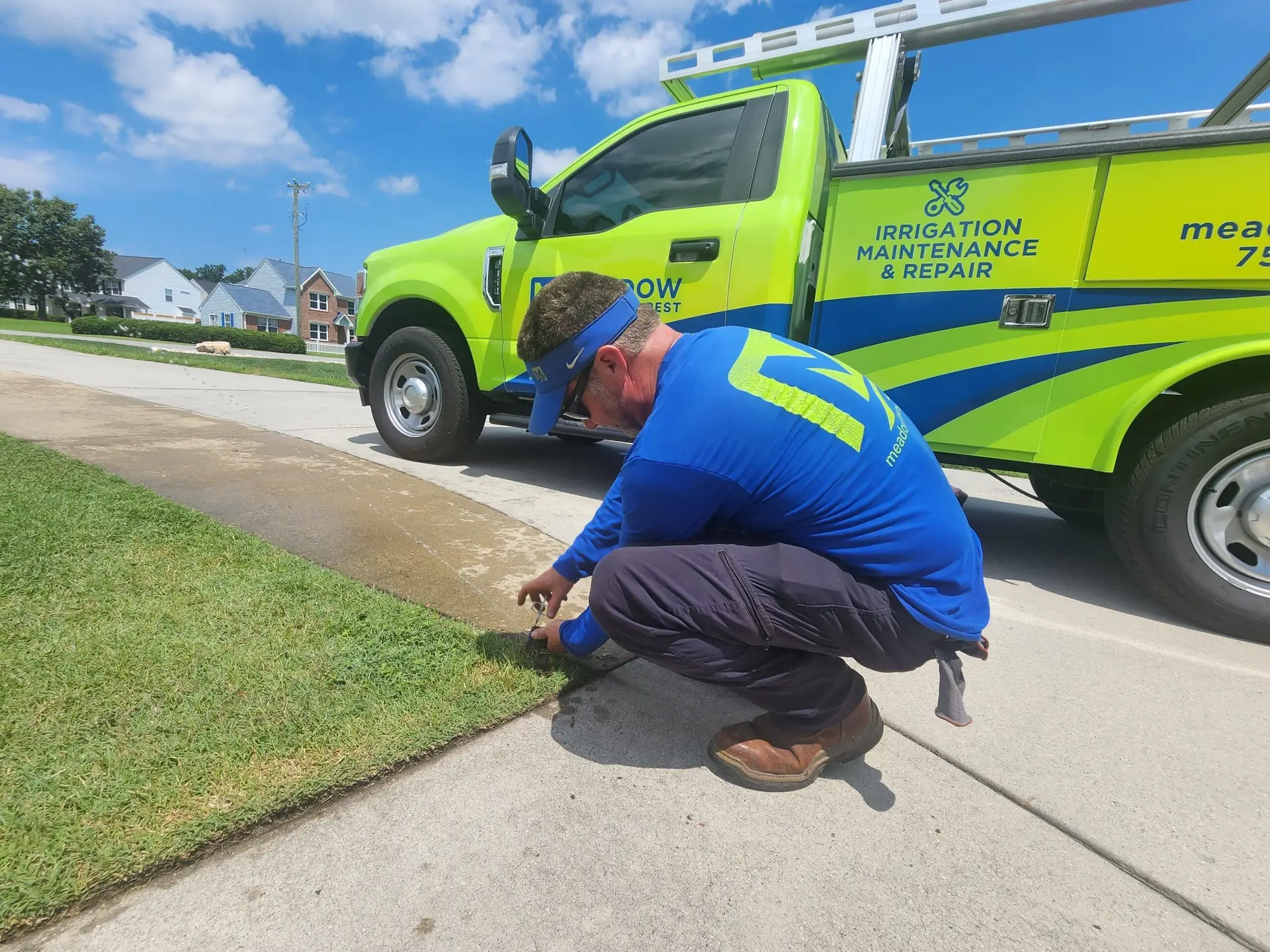
Short Answer: A blowout takes roughly thirty to sixty minutes on a typical residential system. The technician shuts off the water supply, isolates and drains the backflow preventer, connects a compressor at the designated fitting, then runs each zone in sequence so compressed air pushes residual water out through the heads. Zones get a second pass, the controller is shut down for the season, and the backflow device is left open so any remaining water can escape rather than being trapped. Schedule in October, before the first hard freeze.
Irrigation winterization is quick work that looks unremarkable from the driveway, which makes it hard to evaluate. A truck arrives, a compressor runs, water sprays out of the heads for a while, and the crew leaves.
Knowing the sequence makes it much easier to tell whether it was done properly, and there are a few details that separate a thorough job from a fast one. Here is what actually happens.
Before the Crew Arrives
A few things speed the visit and a couple genuinely affect whether it can be completed.
Know where your backflow preventer is. It is usually above ground near the house or the meter, sometimes in a green insulated cover. The technician needs access to it, and if it is buried under overgrown landscaping that has to be cleared first.
Know where the controller is, which is commonly in a garage, a basement, or on an exterior wall. The technician will need to operate it to cycle zones, or will use the system's manual controls.
Make sure the shutoff valve for the irrigation supply is accessible. On many Hampton Roads homes it is in a crawl space or a basement, and a crawl space packed with storage slows things down considerably.
If you know of problem zones, heads that have not been working, or repairs made during the season, mention them. That context is useful during the visit, and a blowout is a good moment to identify issues to address at spring startup rather than discovering them in April.
Shutting the System Down
The first step is isolating the system from the water supply, which is more than just turning off the controller.
The supply valve gets closed so no new water enters the lines during the process. Then the backflow preventer is addressed, since it is the component most at risk and it needs particular handling.
The device gets isolated using its own valves, and the test cocks are opened so water trapped inside can escape. On many devices the ball valves are then left at a partial angle rather than fully closed, so that any water remaining in the body has room to expand rather than being sealed in.
That detail is small and it matters. A backflow preventer left fully closed with water inside is exactly the situation that cracks brass, and it is the thing most commonly missed when a homeowner attempts winterization themselves.
Running the Zones
The compressor connects at a fitting installed for the purpose, usually downstream of the backflow device.
Zones then get run one at a time, in sequence. When air reaches a zone, the heads pop up and water is driven out as a heavy spray that quickly turns to mist and then to just air. That transition from water to mist is the visual signal that a zone is clearing, and it is what you see in the photos of this work.
Each zone runs only briefly. Air moving through a dry line generates heat, and running a zone after the water is gone can damage heads and gears. A technician watches for the transition and moves on rather than running a fixed timer.
Zones are then cycled a second time. Water redistributes within a system after the first pass, settling into low points, and the second round catches it. A blowout that runs each zone once is not finished.
Drip zones and micro spray in beds get the same treatment, and they are easy to overlook because they are not visible the way turf heads are. Small diameter tubing holds water and emitters are vulnerable.
Pressure Is the Detail That Matters
This is the part where equipment and judgment separate a professional job from a risky one.
Too little pressure and volume fails to move water out of the lines, so the system looks blown out and is not. Too much pressure damages the components you are trying to protect, including heads, fittings, and valve diaphragms.
The appropriate range depends on pipe material, with PVC systems requiring more caution than polyethylene. A technician should know or determine which is in the ground before starting.
Volume is the factor homeowners underestimate. Moving a column of water through a lateral requires substantial airflow, not just pressure, and this is where small compressors fail even when the gauge reads correctly. The equipment used for this work is considerably larger than what most people have in a garage.
A regulator on the compressor is not optional, since compressors deliver far more pressure than an irrigation system tolerates.
Finishing the Job
A few closing steps determine whether the system stays protected through the winter.
The controller is shut down for the season. On most modern controllers there is an off or rain mode position that preserves your programming while preventing the system from running. Simply unplugging it works too, though some controllers lose settings without power and a battery backup.
This step matters more than it sounds. A controller left on will attempt to run zones during a warm spell in February. With the supply off nothing happens hydraulically, but valves and solenoids cycle unnecessarily, and if anyone turns the water back on for an unrelated reason you have an unprotected system running in winter.
The backflow device is left in its winter position with test cocks open and valves partially open. Insulated covers can go back on, and they are a useful supplement once the water is out.
You should also get a note on anything found during the process. Heads that did not pop up, zones that did not activate, or a leak that revealed itself under air are all worth knowing now. A zone that will not activate during a blowout usually points to a wiring or solenoid problem, and finding that in October is considerably better than finding it in spring.
Why Two Passes Matter
This is the step most commonly shortened and it is worth understanding why it exists.
When a zone is blown out, air takes the path of least resistance through the line. It clears the main run efficiently and leaves water behind in low spots, at fittings, and in sections that branch off the primary path. Some of that water then migrates back toward the low points once the air stops.
Running the zone a second time, after the others have been done, catches that redistribution. The second pass typically produces noticeably less water than the first, which is the confirmation that the zone is genuinely clear rather than just quiet.
When to Schedule
The deadline is the first hard freeze, which around Hampton Roads typically lands somewhere in November and occasionally earlier.
October is the right month to book. The system has finished its working season, the weather is comfortable for the work, and there is buffer before the first cold night.
The mistake we see most often is waiting for a freeze in the forecast. At that point every irrigation contractor in the region is fielding the same calls in the same week, and schedules fill within a day or two. People who wait frequently do not get served before the cold arrives.
If your lawn is cool season fescue and still actively growing, it is reasonable to keep watering into October. Schedule the blowout for the end of the month rather than shutting the system down early, and the two goals do not conflict.
What to Do Next
Find your backflow preventer and your supply shutoff valve today, and clear access to both if landscaping or storage is in the way. That single step prevents the most common delay.
Book the service for October rather than waiting on the forecast, since availability tightens sharply once the first cold snap appears in the ten day outlook.
Note any zones or heads that misbehaved this season so they can be flagged during the visit and addressed at spring startup.
Here is what to expect on the day. Thirty to sixty minutes for a typical residential system, heads spraying water and then mist as each zone clears, a second pass through the zones, and the controller shut down before the crew leaves.
To get on the schedule before the first freeze, call Meadow Lawn and Pest at 757-238-8901 or visit meadowlawnandpest.com. We serve Carrollton, Smithfield, Windsor, Suffolk, Chesapeake, Hampton, Newport News, Poquoson and York County.