
Mosquito Control
Where Mosquitoes Actually Breed on a Hampton Roads Property
Meadow Lawn & Pest • October 2026 • Carrollton & Hampton Roads, VA • 7 min read
Short Answer: Every mosquito starts life in standing water, and it takes remarkably little. A bottle cap holds enough. On a Hampton Roads property, the sources fall into two groups. Containers and clogged gutters produce the daytime biters that came from your own yard, and those you can eliminate. Tidal ditches, marsh edges, and wet low ground produce salt marsh mosquitoes that fly in from well beyond your property line. Source reduction handles the first group completely and the second not at all.
Every mosquito that bites you started in standing water. No species skips the step and there is no way around it, which means every mosquito problem is at some level a water problem.
That is mostly good news, because water is something you can find and remove without buying anything. The complication in this region is that some of the water is not on your property and never will be. Here is how to sort out which is which.
How Little Water It Takes
The volume required surprises people. A bottle cap holds enough water for mosquitoes to complete a life cycle. Not comfortably, but enough.
The practical threshold is any water sitting undisturbed for about a week or more. Depending on species and temperature, eggs can go from laid to flying adult in roughly eight to twelve days in warm weather. A container that fills with rain and takes ten days to dry is a production site, and it becomes one again after the next storm.
Moving water is generally fine. Creeks, tidal water with real flow, and anything with a pump running are not where mosquitoes lay. Still water is the target, and stagnant water with organic material rotting in it is the most attractive of all to the Culex species that bite at dusk.
The Container Walk
Do this a day or two after rain, which is when sites reveal themselves. Anything still holding water then is a site.
Start at the gutters, because in October they are the leading offender. Leaves are coming down, and a gutter packed with wet debris holds a standing trough along the entire roofline. It is the largest breeding site on many properties and almost nobody looks up. Check downspout extensions too, particularly corrugated plastic, which holds water in every ridge and never fully drains.
Move to the porch and patio. Plant saucers under pots are the classic. Bird baths need dumping and refilling weekly to be safe. Pet bowls left outside, decorative containers, and anything ornamental with a depression all qualify.
Then the sides of the house. Trash and recycling lids that hold water in the rim, buckets, and the recycling itself, since bottles and cans fill readily. Air conditioning condensate creating a persistent damp spot.
Finish in the back. Tarps over furniture, grills, firewood, or a boat, which sag and collect water in folds, and this is the group that expands in fall as people cover things for the season. Children's toys, sandbox lids, wheelbarrows stored upright, old tires, and fire pits that fill between uses. Boats and trailers with covers matter here more than in most markets given how many people in Hampton Roads have them.
What You Cannot Fix
This is the part that separates coastal Virginia from an inland yard, and being straight about it prevents a lot of frustration.
Salt marsh mosquitoes breed in the tidal marshes and brackish low ground that define this region. They are aggressive daytime biters and they are strong fliers, capable of traveling well beyond the marsh they emerged from. That means a property in Poquoson, along the Pagan River, or anywhere near the extensive wetlands through Suffolk and Chesapeake receives mosquitoes it did not produce.
Their production is driven by tidal flooding rather than by rainfall alone, which is why pressure sometimes spikes when there has been no rain to explain it.
Drainage ditches are the middle category. Many neighborhoods here have roadside and rear lot ditches that hold water between rains, and those produce mosquitoes. Whether you can do anything about one depends on whether it is on your property, and in a lot of cases it is a locality or an easement matter rather than a homeowner one.
None of this means source reduction is pointless. It means it addresses one half of your mosquito pressure completely and the other half not at all, and knowing which half you are dealing with tells you what else is worth doing.
Fix It Rather Than Just Emptying It
There is a real difference between tipping water out and removing a site, and it decides whether you do this once or every week.
Where you can, store it. Turn buckets and wheelbarrows upside down, bring plant saucers inside, and put toys away for the season. A container stored empty cannot refill.
Where you cannot store it, drill it. A couple of drainage holes in the bottom of a container that must stay outdoors solves it permanently. Tarps should be pulled tight so water runs off rather than pooling in folds.
Where the water is structural, fix the structure. Clean gutters properly rather than poking at them, replace corrugated downspout extensions with smooth pipe that actually drains, and address low spots that hold water rather than dumping them after every storm.
Where you want to keep the water, keep it moving or treat it. Bird baths need weekly dumping. Ornamental features need a pump. Rain barrels need tight screening over every opening, and they are a common oversight on properties where everything else has been handled.
Doing It Before Winter Matters
There is a timing reason to handle containers now rather than in spring, and it is not obvious.
Container breeding mosquitoes lay eggs above the waterline rather than on the water itself. Those eggs survive freezing and hatch when spring rain refills the container. So a plant saucer left out through winter is a spring breeding site with the eggs already sitting in it.
Clearing and storing containers in October therefore removes both the rest of this season's production and a meaningful share of next spring's first wave. That is a better return on an afternoon than the same work in April would give you.
Gutters follow the same logic. Clearing them once leaves are down eliminates standing water through the winter and means you are not starting spring with a full trough along the roofline.
Where Treatment Fits
Source reduction stops the next generation. It does nothing about the adults biting you tonight, and nothing about the ones flying in from the marsh.
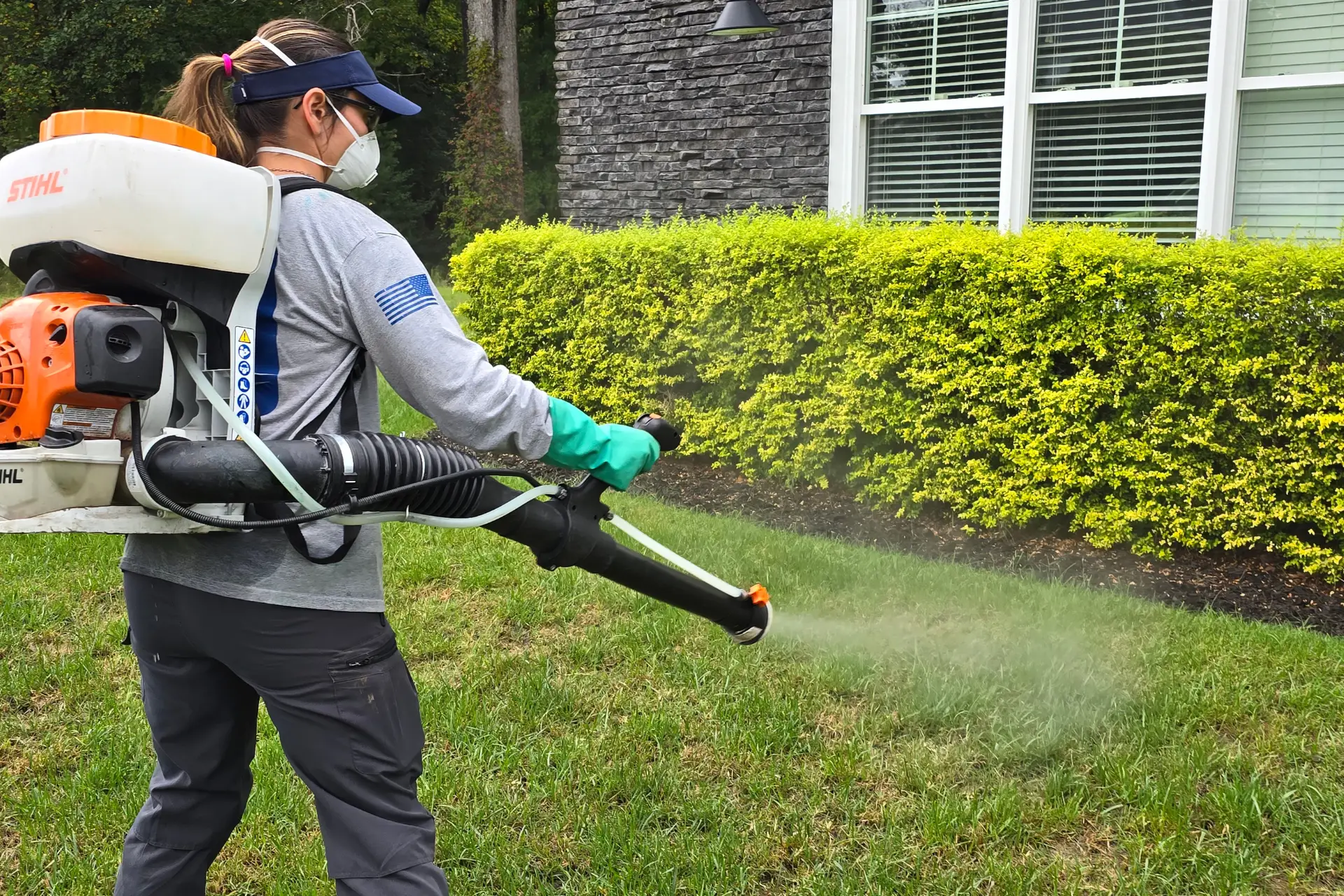
That is what barrier treatment addresses, and it works by targeting where adult mosquitoes spend the day. They do not hover in open lawn. They rest in cool, shaded, humid places with still air, meaning the undersides of leaves, dense shrub beds, ivy and ground cover, under decks, and along fence and tree lines.
Treatment applied to those surfaces reduces the resident population, including mosquitoes that arrived from elsewhere and settled in to rest on your property. On a coastal lot with marsh nearby, that matters more than it would inland, because the arriving population is a larger share of the problem.
Applications generally hold a few weeks before breaking down with sun and rain, so it is a recurring service rather than a one time fix. Properties that do both, removing what they can and treating resting habitat for what they cannot, get noticeably better results than properties doing either alone.
What to Do Next
Pick a day this week, ideally a day or two after rain, and walk the full perimeter with a bucket in hand. Dump everything holding water as you go, and note anything you cannot dump so you can return with tools.
Clear the gutters once leaves are mostly down, and check the downspout extensions while you are up there. On most properties here that single job removes more breeding habitat than everything else combined.
Store what you can for the season rather than leaving it out, which handles both the rest of this fall and the overwintering eggs that would otherwise start next spring for you.
Then be realistic about the rest. If you back onto marsh, tidal ditch, or wetland, source reduction alone will not get you where you want to be, and that is the situation barrier treatment exists for.
To have someone walk the property, identify the sites you are missing, and treat the resting habitat, call Meadow Lawn and Pest at 757-238-8901 or visit meadowlawnandpest.com. We serve Carrollton, Smithfield, Windsor, Suffolk, Chesapeake, Hampton, Newport News, Poquoson and York County.