
Mosquito Control
Are Mosquitoes Still a Problem in Hampton Roads in October?
Meadow Lawn & Pest • October 2026 • Carrollton & Hampton Roads, VA • 7 min read
Short Answer: Yes, and the late stretch of the season is the part that matters most. Mosquitoes stay active here while temperatures hold above roughly sixty degrees, which in Hampton Roads regularly means into November. Our mild coastal autumns deliver plenty of those days. Late season also tends to carry higher disease risk, because the proportion of infected mosquitoes builds as the season progresses. That makes October a poor month to stop paying attention, even though the worst of the biting is behind you.
By the middle of October most people have decided mosquito season is over. The humidity has broken, evenings are pleasant, and the bug spray has gone back in the garage. Then there is a warm Saturday, you spend an hour on the patio, and you come in with bites wondering what happened.
Nothing unusual happened. Mosquito season in Hampton Roads runs later than almost anywhere people expect, and the tail of it carries some specific reasons to keep paying attention. Here is what is actually still out there.
Temperature Runs the Season, Not the Calendar
Mosquitoes are cold blooded, so their activity tracks the air around them rather than the date on the calendar. There is no point at which they collectively decide the year is finished.
Broadly, they remain active while temperatures hold above roughly sixty degrees, slow noticeably in the fifties, and largely stop flying below about fifty. Those are not hard lines, and they vary by species, but they explain the pattern people notice.
Coastal Virginia is particularly good at extending this. Water moderates temperature, so Hampton Roads holds warmth later into fall than inland areas at the same latitude. We get Octobers with mornings in the forties and afternoons in the mid seventies, and every one of those warm afternoons is a functional mosquito day.
The real end of the season comes with sustained cold rather than a single cool snap, and around here that generally means somewhere in November. A first light frost does not finish it, since sheltered spots hold warmth and activity continues in them after open areas have gone quiet.
Late Season Carries the Higher Disease Risk
This is the part we most want people in this region to understand, because the intuition runs backwards.
West Nile virus is carried primarily by Culex mosquitoes. The virus cycles between mosquitoes and birds through the summer, and the share of infected mosquitoes builds as the season progresses. So infection risk per bite tends to be higher in late summer and early fall than it was in June, even as the total mosquito population falls.
Eastern equine encephalitis is the other concern in Virginia, and it is worth knowing about here specifically. It is rare but serious, and it is associated with freshwater swamp habitats. Southeastern Virginia, with the Great Dismal Swamp and extensive wooded wetlands through Suffolk and Chesapeake, is within the region where it has historically been monitored.
We are not trying to alarm anyone. The large majority of bites result in nothing at all, and most West Nile infections produce no symptoms. But the common assumption that October bites are merely annoying while July bites were the risky ones has it exactly backwards, and that is worth knowing when deciding whether protection is still worth bothering with.
Timing compounds it. Culex mosquitoes are most active around dusk and after dark, which is precisely when people are outside in October now that the heat has finally broken.
Our Salt Marsh Problem Is Different
Hampton Roads has a mosquito situation that inland areas do not, and it changes what control can realistically accomplish.
Salt marsh mosquitoes breed in the tidal marshes and brackish areas that define this region. They are aggressive daytime biters, and the important characteristic is that they are strong fliers. Unlike container breeding species that stay within a couple hundred yards of where they emerged, salt marsh mosquitoes can travel substantial distances from their breeding grounds.
The practical consequence is significant. A homeowner in Poquoson, Carrollton, or along the water in Suffolk can do everything right on their own property and still have mosquitoes arriving from marshes they do not own and cannot treat.
That is not an argument against source reduction, which still matters for the container breeders that genuinely do come from your yard. It is an argument for being realistic about what any single approach achieves here, and for why barrier treatment on resting habitat carries more weight in this region than it would somewhere without tidal marsh nearby.
Marsh populations are also driven by tidal flooding rather than by rainfall alone, which is why our mosquito pressure sometimes spikes when there has been no rain to explain it.
What Fall Rain and Storms Restart
The container breeding side of the problem resets quickly this time of year, and fall gives it new opportunities.
Mosquitoes need standing water to breed, and the timeline is short. Depending on species and temperature, eggs can go from laid to biting adult in a bit over a week during warm weather. A rainy stretch in early October can be producing adults by mid month.
Fall adds breeding sites that summer does not have. Leaves accumulate in gutters and create standing troughs. Tarps go over patio furniture, grills, and boats, collecting water in every fold. Fire pits fill and sit. Downspout extensions and corrugated pipe hold water in the ridges.
Tropical systems and nor'easters add another layer here. A storm that drops several inches leaves standing water across low areas, ditches, and containers, and the mosquito production that follows arrives a week or two after everyone has stopped thinking about the storm.
Where They Go When It Gets Cold
Mosquitoes do not migrate and they do not simply die out, which is why they return so reliably each spring.
Culex females overwinter as adults, finding sheltered protected spaces and going dormant until spring. Garages, crawl spaces, sheds, and culverts all work, and crawl spaces are worth noting because so many homes in this region have them. That is why you sometimes see one drifting around a garage on an unseasonably warm February day.
Container breeding species take a different approach, laying eggs above the waterline in containers. Those eggs survive freezing and hatch when spring rain refills the container. A plant saucer left out all winter is next May's mosquitoes sitting in your yard right now.
Neither strategy makes late season work pointless. Reducing the adult population now means fewer females surviving to overwinter and fewer eggs laid for spring, so October effort carries forward past the first frost.
What Actually Helps This Time of Year
Two things, and they address different halves of the problem rather than competing.
Getting rid of standing water is the free one and it is genuinely effective against the species that come from your own property. In fall that specifically means clearing gutters once leaves are down, emptying and storing anything that holds water, checking tarps and covers, and looking at low spots that hold puddles for more than a few days.
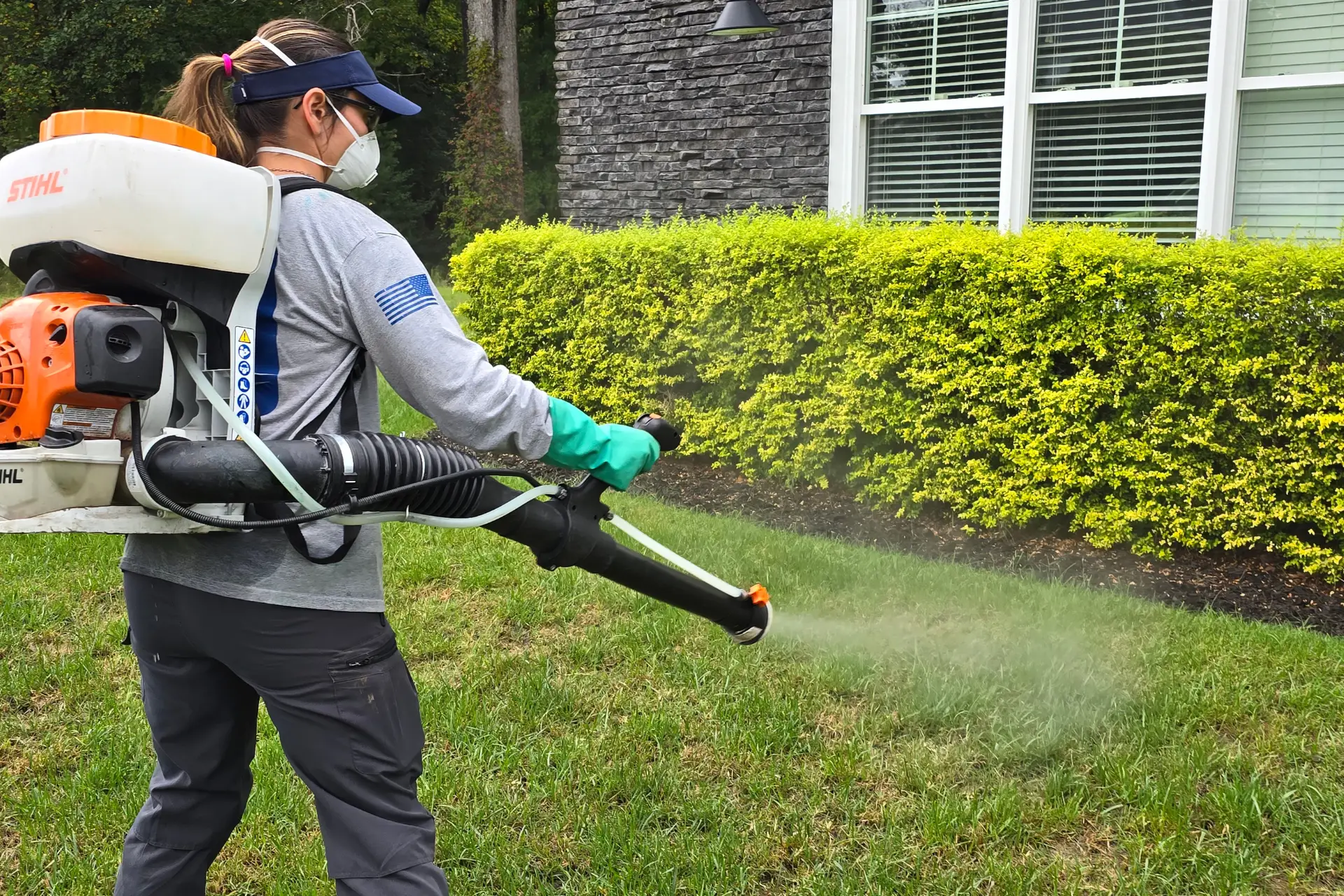
Treating adult resting habitat is the other. Mosquitoes do not hover in open lawn during the day. They shelter in cool, shaded, humid places with still air, which means the undersides of leaves, dense shrubs, ivy and ground cover, under decks, and along fence and tree lines. A barrier treatment targets those areas, which is why the work concentrates on property edges rather than the middle of the yard.
Being honest about duration matters. A barrier application generally holds for a few weeks before breaking down with sun and rain, so it is a window of protection rather than a permanent state. Late in the season that is frequently enough, because the season itself is closing.
What to Do Next
Walk the property after the next rain and look for water still sitting. Gutters, tarps, plant saucers, downspout extensions, fire pits, anything stored upright, and the low corner that never drains. Anything holding water more than about a week is producing mosquitoes.
Dump and store rather than just tipping out, since a container you empty today refills with the next rain and the eggs already laid in it overwinter.
If you are still using the yard on warm evenings, which most people here are through October, treatment covers the remaining active stretch. Expect a noticeable reduction rather than elimination, focused on shaded resting areas and property edges, holding a few weeks rather than the rest of the year.
If you would rather have someone find the breeding sites and treat the resting areas, call Meadow Lawn and Pest at 757-238-8901 or visit meadowlawnandpest.com. We serve Carrollton, Smithfield, Windsor, Suffolk, Chesapeake, Hampton, Newport News, Poquoson and York County.