
Irrigation Blowouts
Why Your Irrigation System Needs a Blowout Before Winter in Hampton Roads
Meadow Lawn & Pest • October 2026 • Carrollton & Hampton Roads, VA • 8 min read
Short Answer: Water expands when it freezes, and there is no component in an irrigation system that tolerates that. Hampton Roads winters are mild enough that homeowners routinely skip winterization, then get caught by the hard freezes we reliably get several times each winter. The backflow preventer is the most vulnerable and most expensive component, sitting above ground with brass parts that crack. Draining a system by gravity does not remove enough water, because lines are not laid to drain perfectly. Compressed air is what clears them.
Irrigation winterization is an easier sell in Minnesota. When the ground freezes solid for four months, nobody questions whether it is necessary. Here in Hampton Roads the winters are mild enough that skipping it feels reasonable, and plenty of homeowners do, year after year, until the winter that does not cooperate.
That is the pattern behind most of the spring repair calls in this region. Here is what actually freezes, why our mild climate makes the problem worse rather than better, and what a blowout accomplishes that draining does not.
What Freezing Water Does to a System
Water expands by roughly nine percent when it freezes, and it does so with enough force that no common plumbing material resists it. That expansion has to go somewhere, and in a closed pipe the only available direction is outward through the pipe wall or the fitting.
PVC becomes brittle in cold and cracks. Polyethylene pipe is more forgiving and still splits under enough expansion. Fittings, which are the weak points in any system, separate or crack at the joint.
Sprinkler heads hold water in the body and in the riser, and a frozen head cracks at the housing or damages the internal seal. A head that survives the freeze may still fail to retract or may weep afterward.
Valves contain diaphragms and solenoids, and ice in a valve body damages components that are not individually replaceable on many models.
The pattern with all of it is that damage is invisible until spring. The system sits quietly all winter, you turn it on in April, and you find out what happened in January.
The Backflow Preventer Is the Expensive One
If there is one component to worry about, this is it, and its exposure is the reason.
A backflow preventer sits above ground, typically near where the irrigation line leaves the house, and its job is to keep irrigation water from flowing back into the potable supply. Because it is above ground, it has no soil insulation at all, and it holds water in a brass or bronze body with internal check assemblies.
Brass cracks when water inside it freezes. Replacement is the most expensive single repair most homeowners face on an irrigation system, well above what a blowout costs, and that is before any plumbing labor.
It is also worth knowing that backflow prevention devices are regulated. Many Virginia localities require these devices to be tested periodically by a certified tester, and a cracked device is both a repair expense and a compliance problem.
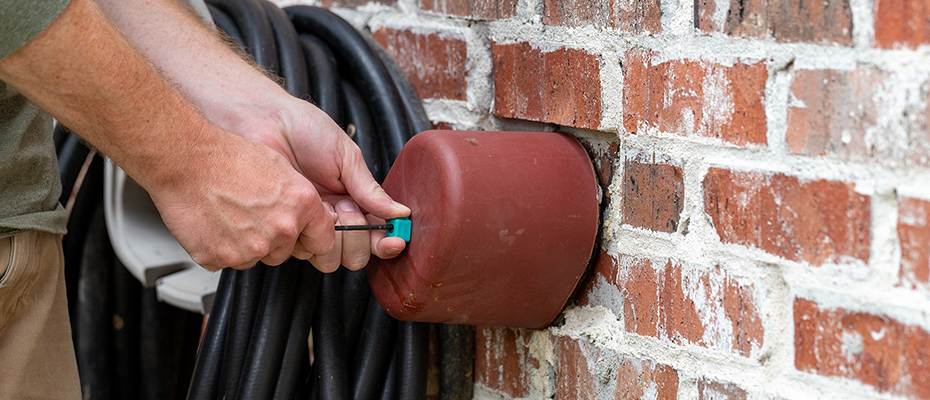
Insulated covers help and they are not sufficient on their own, because a cover slows heat loss rather than removing the water. The water inside is what causes the damage.
Why a Mild Climate Is Worse, Not Better
This is counterintuitive and it explains why we see so much freeze damage in a region people think of as warm.
In a genuinely cold climate, winterization is routine and universal. Everyone does it, contractors are booked for it, and nobody questions the expense. The systems get protected.
Here, mild averages create a false sense of safety. Our typical winter day does not threaten anything. But Hampton Roads reliably gets several hard freezes each winter, and occasionally a serious cold event that pushes well below anything the season average suggests. It only takes one night.
Freeze and thaw cycling makes it worse. A system that freezes, thaws, and freezes again experiences repeated expansion stress rather than a single event, and coastal Virginia produces far more of those cycles than a consistently frozen climate does.
The homeowners we see with damage are rarely careless. They are people who skipped it for five mild winters and got caught by the sixth.
Why Draining Is Not Enough
Some systems have manual or automatic drain valves, and homeowners reasonably assume opening them empties the system. It removes some water and it does not remove enough.
Gravity draining only works where every line slopes consistently toward a drain point. Real systems do not. Lines run around obstacles, cross grade changes, and settle over years, and any low spot holds water that gravity will not move.
Sprinkler heads retain water in the body regardless of what the mainline does. Valve bodies hold water. Lateral lines with any belly in them hold water.
The residual left behind after draining is enough to crack fittings and heads. That is the specific reason compressed air is the standard method rather than an upsell, because air pushes water out of the sections gravity cannot reach.
What Blowing Out Actually Involves
The process is straightforward and the details matter more than it appears.
Water supply to the system is shut off and the backflow device is isolated and drained. Compressed air is then introduced, and each zone is run in sequence so the air pushes residual water out through the heads. What comes out looks like the mist you see in these photos, which is water being carried out by the air rather than the system running.
Zones are typically run more than once, since the first pass clears the bulk and a second catches what redistributes. Each zone is run only briefly, because air running through a dry zone generates heat and can damage components.
Pressure control is the part that separates a proper job from a damaging one. Too much pressure damages heads, fittings, and valves. The appropriate range depends on pipe material, and running shop compressor pressure into a system is a way to cause the damage you were trying to prevent.
Volume matters more than pressure, and this is the detail most people get wrong. A compressor needs enough airflow, measured in cubic feet per minute, to actually move a column of water through a zone. A small shop compressor may reach the right pressure reading and still lack the volume to push water out of a lateral, which means the gauge looks correct while the line stays wet.
Systems That Still Need It Here
A few situations come up in this region that homeowners assume exempt them, and mostly they do not.
Drip irrigation and micro spray in beds still hold water, and the small diameter tubing and emitters are if anything more vulnerable than turf lines. Those zones need clearing along with everything else.
Newer systems are not exempt. Freeze damage is not a function of age, and a two year old backflow preventer cracks on the same night an old one does.
Systems that were winterized last year still need it this year, since the process removes water rather than making any permanent change. And a system that was never used much through the season still holds water in the lines from whenever it last ran.
Timing It Here
The deadline is the first hard freeze, and around Hampton Roads that typically arrives somewhere in November, though it has come earlier.
October is the practical month to schedule. The system is done working for the season, the weather is still comfortable for the work, and there is buffer before the first cold night.
Waiting until the forecast shows a freeze is how people end up unprotected, because every irrigation contractor in the region is fielding the same calls that week and the schedule is already full.
If your system is still running, it is reasonable to keep it going for cool season turf that is still growing, and to schedule the blowout for the end of the month rather than stopping irrigation early. The two do not conflict as long as the blowout happens before the first freeze.
What to Do Next
Locate your backflow preventer and look at it. It is usually above ground near the house or the meter, and knowing where it is matters both for winterization and for shutting the system down in an emergency.
Shut off the water supply to the irrigation system once you are done running it for the season, and turn the controller to the off position rather than leaving a schedule active.
Schedule the blowout for October rather than waiting for the first cold forecast, because availability tightens quickly once the weather turns.
If you have skipped winterization in past years and gotten away with it, that is worth reconsidering rather than treating as evidence it is unnecessary. The damage happens in one night, not gradually.
To schedule a blowout before the first freeze, call Meadow Lawn and Pest at 757-238-8901 or visit meadowlawnandpest.com. We serve Carrollton, Smithfield, Windsor, Suffolk, Chesapeake, Hampton, Newport News, Poquoson and York County.