
Short Answer: Hampton Roads has all three of the disease-carrying ticks Virginia homeowners need to worry about: lone star, American dog tick, and blacklegged (deer) tick. June through September is peak exposure. Protection has three layers that all matter. Yard zone management cuts tick populations 60 to 90 percent: shrink and divide harborage zones, treat ecotone edges, manage the deer attractant pressure. Personal protection (treated clothing, repellents, daily tick checks) covers the ticks you still encounter outside the yard. Pet protection through veterinary-prescribed products closes the gap on the most common source of household tick introduction. The yard fogging spray that some companies promote without addressing edges is mostly theater. The combination of these three layers, done properly, produces near-zero tick incidents on a typical Hampton Roads property. Here is how to build all three.
Tick exposure is the pest issue Hampton Roads homeowners ask us about with the most worry behind it. The reason is straightforward. Ticks transmit serious diseases. Lyme disease, Rocky Mountain spotted fever, alpha-gal syndrome, ehrlichiosis, anaplasmosis, and several other conditions are all in Virginia. Children playing in the yard, dogs running fence lines, adults gardening in beds, all create realistic exposure paths. The worry is justified, and the protection is also achievable. We have walked hundreds of Hampton Roads properties through tick reduction programs and the math is clear: properties that approach this seriously see tick incidents go to near zero. Properties that handle it casually live with the worry all summer.
This post is the full picture. What ticks we actually have in coastal Virginia, where they live on properties, what works to reduce them, what is marketing without science, and how to protect family and pets even when you are off property. We will be specific about products and timing because vague advice is what makes tick protection fail.
The Three Ticks That Matter in Hampton Roads
Lone Star Tick (Amblyomma americanum)
The most common tick we encounter in Hampton Roads. Adults are reddish brown with a single white spot on the female’s back. Males are darker and patterned. Aggressive hunters that actively pursue hosts. Active April through September with a strong July peak. Carry ehrlichiosis, southern tick-associated rash illness, and are the primary vector for alpha-gal syndrome (the red meat allergy that has become more common in coastal Virginia). They prefer humid wooded edges and tall grass.
American Dog Tick (Dermacentor variabilis)
Second most common locally. Larger than lone stars, brown with mottled white or gray markings on the back. Less aggressive in pursuit but very common on dogs and in rural settings. Active April through August. Primary vector for Rocky Mountain spotted fever in our area. Prefer grassy edges, fence lines, and paths.
Blacklegged or Deer Tick (Ixodes scapularis)
Less common but expanding in Hampton Roads. Smaller than the other two, with reddish bodies and dark legs. Larvae and nymphs are particularly small, sometimes the size of a poppy seed. Active spring through fall with a smaller peak in October and November as well. Primary vector for Lyme disease, anaplasmosis, and babesiosis. Prefer dense leaf litter and deep brush.
Each of the three has different habitat preferences and different favorite life stages, which matters for treatment. A program designed only for lone stars often misses dog ticks in fence lines and blacklegged ticks in leaf litter.
Where Ticks Actually Live on Hampton Roads Properties
The yard zones that host ticks are predictable. Walking a property with a tick map in mind, we look for:
- The ecotone edge: where lawn transitions to woodland, shrub border, or unmaintained area. This is the highest-density zone on most properties. Lone stars and dog ticks both concentrate here. Often more than half of all ticks on a property live in a band 6 to 10 feet on either side of this transition.
- Dense shaded ground cover: ivy beds, vinca, pachysandra, and similar low ground covers retain humidity and shelter ticks at the soil line.
- Leaf litter zones: any area where leaves accumulate (under decks, against fences, at the base of mature trees) creates blacklegged tick habitat.
- Stone walls, rock piles, and woodpiles: rodent harborage, and rodents are key hosts for blacklegged tick nymphs.
- Tall grass strips: fence lines, drainage easements, and any unmowed strip of more than 8 inches becomes a tick highway.
- Deer trails and bedding areas: properties backing to woods often have visible deer paths. These deliver fresh ticks to the property continuously through the season.
The middle of an open mowed lawn is essentially tick-free. The risk is at the edges and in shaded humid zones. This matters enormously for treatment strategy.
Yard Zone Management: The 60 to 90 Percent Reduction
Before any spray ever touches a property, the structural changes below cut tick populations dramatically. These are the moves that make subsequent treatment effective.
Create a Three Foot Buffer
Wherever lawn meets woods, shrub border, or unmaintained area, create a three foot buffer of wood chips or gravel. This is the single most-effective structural change. Ticks dehydrate quickly crossing this zone and rarely make it through. Use cedar or hardwood chips, not pine straw (which retains moisture). Maintain the buffer year over year. This one move alone cuts ticks entering the lawn by 50 to 70 percent on most properties.
Manage Leaf Litter
Rake leaves out of beds, away from decks, and especially out of areas where children or pets play. Compost or remove. Reducing leaf depth from 3 inches to less than half an inch makes the area inhospitable to blacklegged ticks.
Limit Ground Cover Depth
Dense ground covers like ivy and pachysandra harbor ticks. If they are not essential to the landscape design, replacing high-tick-risk ground covers with lower-risk plantings or mulched beds reduces local populations significantly.
Address Rodent Harborage
Stone walls and woodpiles host mice. Mice host blacklegged tick nymphs. Reducing rodent populations through trapping or by managing the harborage cuts blacklegged tick reproduction by an order of magnitude over a season.
Deer Pressure Reduction
Properties with significant deer pressure see continuous tick reintroduction regardless of yard treatment. Deer fencing is the most effective intervention where the budget supports it. Where it does not, removing landscape plants that attract deer (hostas, daylilies, arborvitae, hydrangeas) and replacing with deer-resistant plantings reduces visit frequency. Repellent products help but require continuous reapplication.
Treatment: Where, When, and What
With structural moves in place, targeted treatment closes the gap. Our standard Hampton Roads tick program looks like this.
What Products Work
Bifenthrin is the workhorse acaricide for residential yard tick treatment. Effective on all three species, residual of roughly 21 to 30 days, low cost. Cyfluthrin and lambda-cyhalothrin are similar synthetic pyrethroids with similar performance. For homeowners wanting to avoid pyrethroids around pollinators, products containing nootkatone are emerging as a more bee-safe option with shorter residual.
Where to Treat
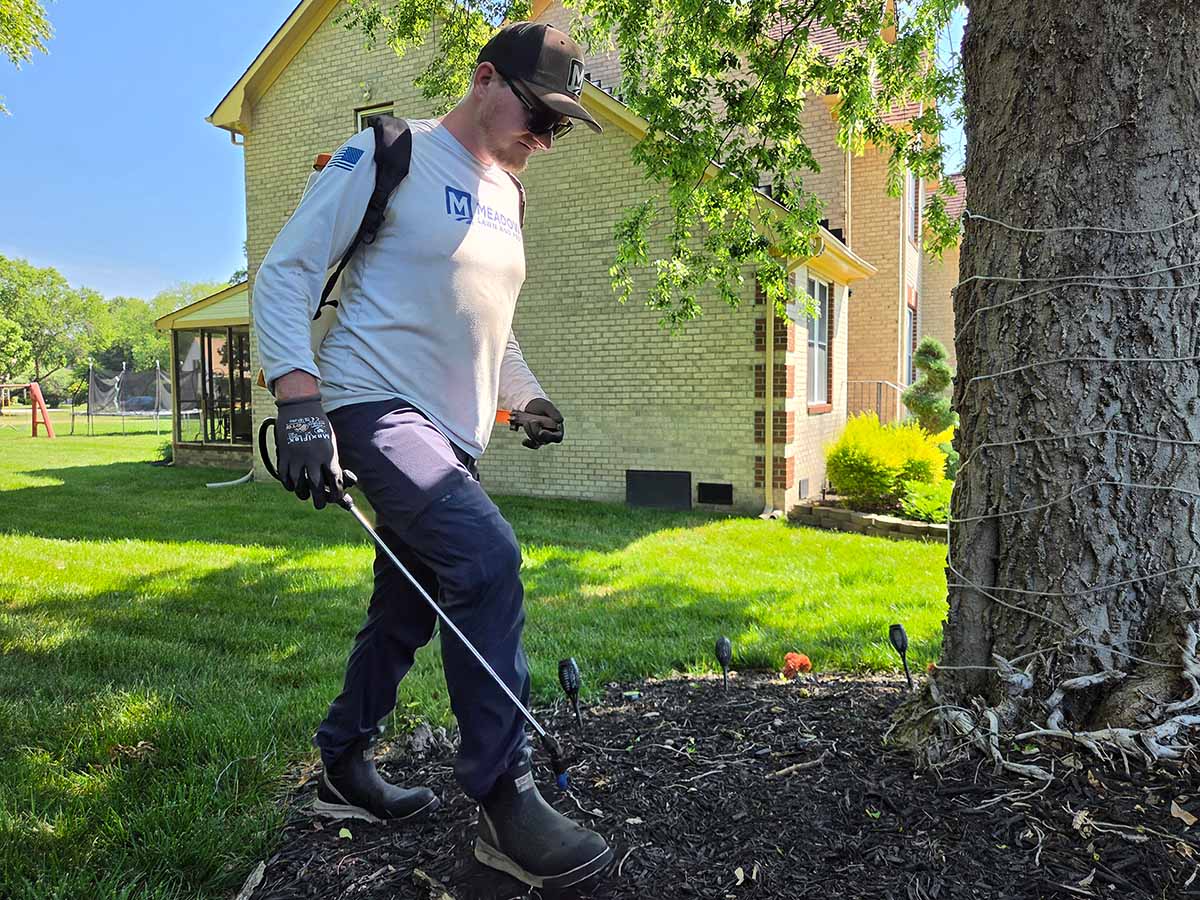
Concentrate treatment on the high-density zones identified above. Heaviest application at the ecotone edge band. Targeted application in shaded ground cover, along fence lines, at the base of stone walls and woodpiles. Lighter application across open lawn (where tick density is low anyway). Spraying the entire lawn uniformly wastes product and disturbs beneficials without proportionally reducing ticks. Spraying only the edges and harborage is what works.
When to Treat
Three to four applications across the season is the standard for Hampton Roads. First application late April or early May before nymph activity peaks. Second application early to mid June. Third application early to mid July (this is the peak month). Fourth application late August into early September. Five-visit programs add a follow-up in late September or early October for blacklegged tick fall activity.
Per-visit cost runs $100 to $180 for a typical residential property. A full-season program lands at $400 to $700. The cost is real but compares well against the medical and family wellness cost of a single tick-borne disease.
What Is Theater
A few practices get marketed but do not actually move the needle.
Whole-yard fogging with no edge or harborage focus. The fog drifts where it drifts and most of the tick population is in zones the fog does not reach.
Garlic sprays, essential oil products, and natural barriers without acaricide active ingredients. Some have modest short-term repellent effect; none significantly reduce population. They can be useful as part of an integrated program but should not be the primary intervention.
Backyard fogger devices sold at home improvement stores. Many do not contain acaricides at all; they contain mosquito-targeted pyrethroids at concentrations that do not effectively kill ticks.
Birdhouses marketed as tick predator habitat. Birds do eat some ticks but the population impact is negligible at residential scale.
Foliar sprays on ornamental plants away from harborage. Ticks rarely climb above 18 to 24 inches in vegetation. Treating ornamental tree canopies for ticks is wasted product.
Personal Protection Layer
Yard treatment cuts on-property exposure dramatically but it does not eliminate exposure on hikes, at parks, in yards you visit, or on the dog who came back from the groomer. Personal protection covers the gap.
- Permethrin treated clothing for any outdoor work or hiking. Sprays last through several washes; factory-treated clothing lasts dozens of washes. Especially worth it on socks, pant legs, and outdoor work clothing.
- DEET or picaridin repellent on exposed skin. Effective on adults and most children. Picaridin smells better and works similarly.
- Light colored clothing makes ticks easier to spot before they attach.
- Tuck pants into socks when working in tick-prone areas. Ticks climb up; the tuck forces them to the visible exterior of clothing.
- Daily tick checks after any outdoor time during peak season. Full body, including scalp, behind ears, in armpits, behind knees, around the waist. Quick removal with fine-tipped tweezers reduces disease transmission risk dramatically.
- Shower within two hours of coming inside. Washes off unattached ticks.
Pet Protection
Dogs are the most common way ticks enter households. A dog running a fence line can bring 20 to 50 ticks inside in a season. Pet protection matters more than most homeowners realize.
Veterinarian-prescribed oral products (Bravecto, Simparica Trio, NexGard) provide excellent protection and far better consistency than topicals. Cost is $80 to $200 per quarter depending on dog size. The single best investment in household tick reduction beyond yard treatment.
Topical products (Frontline, Advantix) still work for some dogs but require correct monthly application and can be partially washed off in pools or lakes.
Cats: tick exposure is real for indoor-outdoor cats. Discuss appropriate products with the veterinarian. Never use dog tick products on cats; some are fatal.
Tick checks on pets after they have been outside. Look behind ears, around the collar, between toes, in the groin. Tick combs purchased at pet stores work well for finding partially attached ticks.
What to Do After a Bite
Remove the tick with fine-tipped tweezers grasping as close to the skin as possible. Pull straight up with steady pressure. Do not twist, burn, smother with oils, or use folk remedies that prolong attachment. The longer a tick is attached the higher the transmission risk for any disease it carries.
Photograph the tick for identification. Save in a sealed plastic bag with a date in case symptoms develop. Note the bite location.
Watch the bite for 30 days. Rashes (especially the bullseye associated with Lyme disease), flu-like symptoms, joint pain, or unusual fatigue all warrant a call to a doctor. Carrying a photo of the tick to that appointment is useful.
Lyme disease prophylaxis with a single dose of doxycycline can be appropriate if the tick was attached more than 36 hours and was a blacklegged tick. Discuss with a physician within 72 hours of removal.
Frequently Asked Questions
How much of a yard can be made truly tick-free?
The open interior portions of a maintained lawn can be made effectively tick-free with proper edge management and treatment. The edges themselves remain higher risk regardless of treatment because new ticks arrive on wildlife continuously. Plan for the interior of the lawn to be safe for play and the edges to require personal protection.
Do tick tubes work?
Cardboard tubes filled with permethrin-treated cotton (sold under names like Damminix or TickTubes) target blacklegged tick nymphs through their mouse hosts. They work, particularly when deployed in spring and late summer. Best used as part of an integrated program rather than as a standalone solution.
Are essential oil sprays safe alternatives?
Some have modest repellent effect on adult ticks. None significantly reduce population. They are reasonable additions where pyrethroids are not wanted (around pollinator gardens, near sensitive water features) but should not be the primary intervention if children or vulnerable family members use the yard.
How fast can a tick disease develop after a bite?
Rocky Mountain spotted fever can develop within 2 to 14 days. Lyme disease symptoms usually appear 3 to 30 days after attachment. Alpha-gal can develop weeks to months after multiple lone star tick bites. Any sustained symptoms after a known bite warrant medical attention.
What to Do Next
If you want a tick risk walk of your property with a customized treatment plan, we are glad to come out. We will identify the high-risk zones, recommend structural changes, and put together a treatment schedule for the rest of the season. We serve Hampton Roads including Newport News, Norfolk, Virginia Beach, Chesapeake, Suffolk, Smithfield, Carrollton, Isle of Wight County, and surrounding communities.
Call us at 757-238-8901 or visit meadowlawnandpest.com to schedule a consultation.