
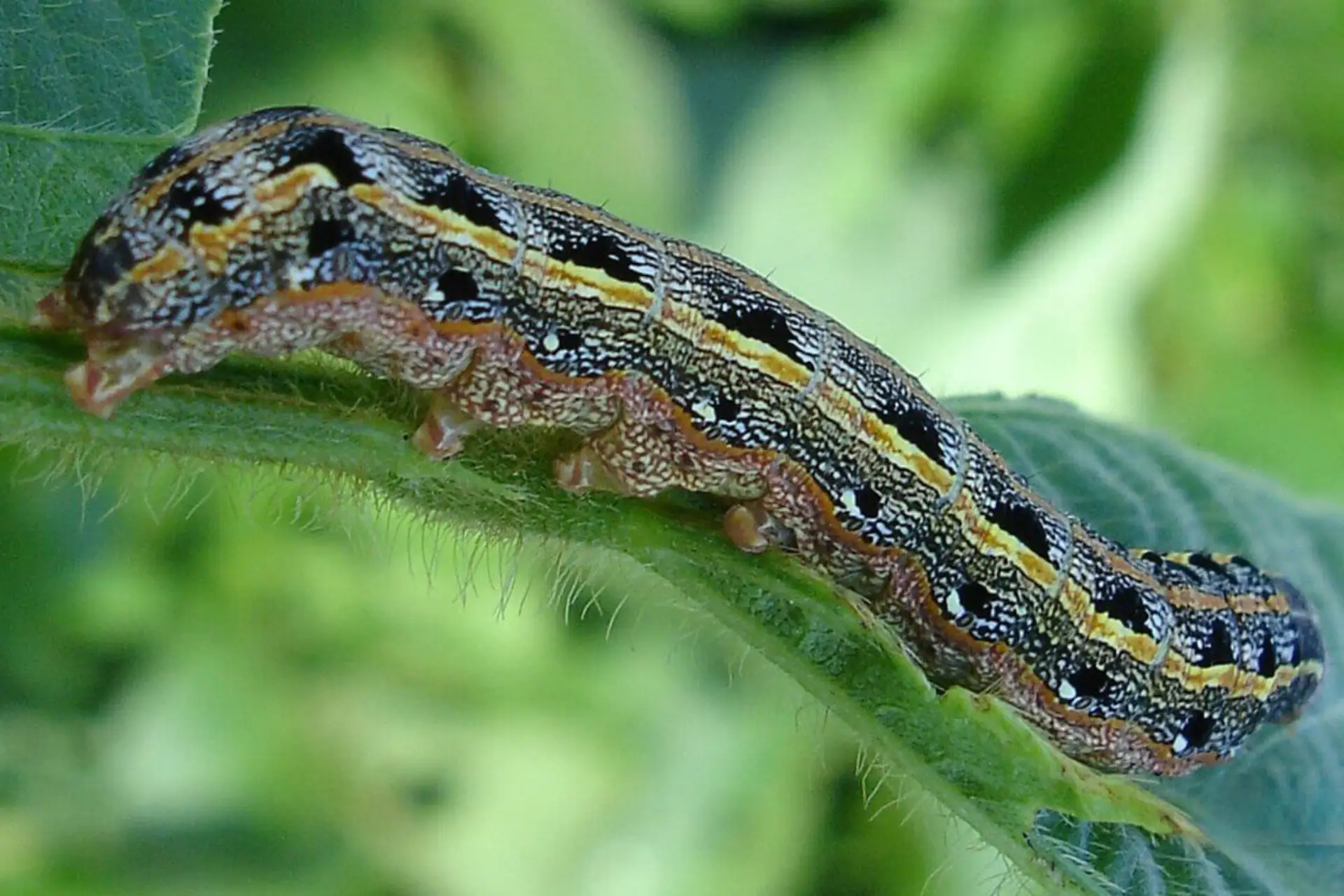
Short Answer: Sod webworm and fall armyworm are the two summer caterpillars that can take a Tidewater Virginia lawn from looking fine to looking destroyed in 48 to 72 hours. They are different insects with different habits but the early signs are similar and the catch window for each is narrow. Sod webworm builds slowly through July with peak damage in late July to early August. Armyworm marches in fast, usually August through September, sometimes earlier in hot years. The diagnostic moves are the same. Watch for early evening moth flushing when you walk the lawn. Look for chewed blade tips and notched margins on individual grass blades. Do a soap flush in suspect areas. Count larvae per square foot. Treat at threshold, not after visible damage. Here is everything you need to spot, confirm, and treat both pests before they cost you the lawn.
The phone calls we get most often in late July and August are about lawns that looked acceptable on Monday and looked devastated by Wednesday. The homeowner is confused, irritated, and frequently certain the issue is irrigation or fertilizer or some new product the neighbor used. Most of the time, after a 10 minute walk, the cause is one of two caterpillars: sod webworm or fall armyworm. Both are common in Tidewater Virginia. Both can take a healthy lawn down inside three days. Both are easily treatable when caught in the first 24 hours of activity and very expensive to recover from when not.
This post is the diagnostic guide that lets you catch them. We walk through the life cycles, the field signs broken down by day, the soap flush test, the threshold count for treatment, the right products, and the recovery timeline. We focus on Tidewater Virginia conditions specifically because timing in our area is roughly two weeks earlier than central Virginia and we get hit harder by armyworm pressure from southern populations moving up the coast.
What Sod Webworms Actually Are
Sod webworms are the larvae of small cream-colored moths (Crambidae family) that hold their wings folded along their bodies when at rest, looking like grass blades themselves. The adult moths do not damage lawns. Their job is to lay eggs in the grass canopy. Each female lays 200 to 400 eggs across a few nights.
The damaging stage is the larvae. They hatch in 7 to 10 days, are tiny at first, and feed at night on grass blades. They retreat into silken tunnels and shallow burrows at the soil surface during the day. As they grow they consume more grass per night. A mature sod webworm larva (roughly three quarters of an inch long, tan or gray with dark spots) can eat several blades of grass each night.
Two generations per year in Tidewater Virginia. The summer generation, which is the destructive one for lawns, has adults emerging in late June and July, eggs laid through July, larvae feeding from late July through August. A smaller fall generation follows in September.
Sod webworms prefer:
- Sunny lawns with dense thatch
- Bermuda, zoysia, and bluegrass blends
- Tall fescue under heat stress (less preferred but susceptible)
- Lawns with moderate to high nitrogen status (lush growth supports more larvae)
What Fall Armyworms Actually Are
Fall armyworms (Spodoptera frugiperda) are the larvae of dark brown to gray moths with light flecks on the forewings. The name comes from their behavior. When populations build, they march across lawns in coordinated fronts that consume everything as they go, like an army crossing terrain.
Armyworms do not overwinter in Virginia. Populations build up over the summer in the southern United States and migrate north on weather patterns. Some years they barely reach Tidewater Virginia. Other years they devastate. The trigger for major years is typically a hot dry spring and summer in the south plus the right weather systems carrying moths northward.
Larvae are larger than sod webworms (full grown is 1.5 inches long, dark green to black with stripes along the body and a distinctive inverted Y mark on the head). They feed in daytime as well as at night, which is part of why damage accelerates so fast.
Armyworm activity in Tidewater Virginia typically runs:
- First wave: late July to mid August in hot years; mid August to early September in normal years
- Multiple overlapping waves if conditions stay favorable
- Activity continues until the first hard frost
Armyworms attack:
- All warm-season turf (Bermuda, zoysia, St. Augustine)
- Tall fescue (heavily)
- Pastures and hayfields
- Ornamental and vegetable crops
Field Signs by the Day
Catching either pest at day one or day two is the difference between a $100 treatment and a $2,000 renovation. Here is what to watch for, in order.
Days 1 to 3 of Activity
Moths flushing out of the lawn when you walk across it at dusk. A small cloud of small lighter colored insects flying up from your feet means adult moths are present and likely laying eggs. This alone is not damage but it is the signal to start monitoring closely.
Subtle blade-tip chewing visible on close inspection. Get on hands and knees and look at individual blades in suspect areas. Healthy grass has clean leaf tips. Caterpillar feeding leaves ragged, notched, or missing tips.
Tiny green to dark frass (caterpillar droppings) at the base of grass blades. Look like grains of black or green sand at the soil surface.
Days 4 to 7
Faint thinning visible from standing height in patches. The grass blade density drops noticeably. The lawn starts to take on a slightly off-color appearance, sometimes described as a faded or grayed look.
Birds working a specific area heavily in morning. Robins, starlings, and grackles will pull caterpillars from the soil at dawn. A flock concentrated in one corner of the lawn is a strong tell.
Small bare patches at the edge of thinning areas, particularly where mowing height is shortest or where sun exposure is highest.
Days 8 to 14
Patches of brown to bare ground, often expanding outward from the original feeding area. The shape can be irregular for sod webworms (which feed in scattered tunnels) and front-edged for armyworms (which march in a line). This is the visible damage stage. From here, escalation is fast.
Days 14 Plus
Whole lawn or whole sections destroyed. Recovery requires fall renovation, reseeding, or sodding. The cost between catching at day 3 and catching at day 14 is roughly $100 versus $1,500 to $3,000 on a typical residential lawn.
The Soap Flush Test
The single best diagnostic tool for either pest. Easy, cheap, and definitive.
Mix 2 tablespoons of any dish soap (lemon scented Joy is what most agronomists use, but any dish soap works) into one gallon of water. Pour slowly and evenly over a one-square-foot area at the edge of a suspect patch. The edge is more diagnostic than the center because that is where larvae are actively feeding.
Wait 5 minutes. The soap irritates caterpillars and they come to the surface.
Count what surfaces. The threshold counts:
- Sod webworm: 10 to 15 larvae per square foot warrants treatment
- Fall armyworm: 3 to 5 larvae per square foot warrants immediate treatment (they feed and grow faster, so the threshold is lower)
Run the test at three different locations across the lawn to map distribution. Concentrated populations in one zone warrant treating that zone plus a 10 foot buffer. Widely distributed populations warrant treating the whole lawn.
The soap flush works for chinch bugs, cutworms, and several other surface insects too. It is the swiss army knife of lawn pest diagnostics.
Treatment Products and Timing
Light to Moderate Populations
Spinosad (sold as Conserve professionally, Captain Jack’s at retail) is the lower-toxicity option. Works on caterpillars including both sod webworms and armyworms. Safer for beneficial insects. Higher cost per application. Effective when populations are at threshold rather than at outbreak.
Bifenthrin (Talstar, Bifen XTS) is the pyrethroid workhorse. Effective on both pests, lower cost, longer residual at 14 to 21 days. Less selective; harder on beneficials. Standard choice for moderate populations.
Carbaryl (Sevin) is another option for both. Wide spectrum, immediate knockdown, shorter residual. Useful for situations where fast results matter more than long protection.
Heavy Populations or Confirmed Armyworm Outbreaks
Chlorantraniliprole (Acelepryn) is the long-residual option that protects 60 to 90 days. Expensive but addresses ongoing pressure when armyworm activity is expected to continue.
Methoxyfenozide is another residual-control choice with caterpillar specificity and good environmental profile.
Application Mechanics
Apply in late afternoon or evening when caterpillars are about to emerge for feeding. Daytime applications waste residual on plant surfaces while larvae are in tunnels.
Water in lightly if the product label calls for it. Most pyrethroids work better with light irrigation that moves them into the thatch zone.
Do not mow for 24 to 48 hours after treatment. Mowing removes treated leaf material and reduces residual effect.
Check effectiveness 5 to 7 days after treatment with a second soap flush in the treated area. Counts should drop dramatically. Counts still at or above threshold warrant a second treatment, usually with a different chemistry to manage resistance.
What Not to Do
Do not wait for visible damage to start treatment. By the time the lawn looks bad, the caterpillars are mature and treatment is harder.
Do not water heavily after treatment unless the label specifies. Heavy watering can leach products below the active feeding zone.
Do not over-treat. Repeated pyrethroid applications create resistance and harm beneficial insects that would otherwise help control next year’s populations.
Do not skip identification. The treatment for caterpillars is different from the treatment for grubs, billbugs, or chinch bugs. Spraying broadly without knowing the target wastes product and may not address the actual problem.
Do not assume one pest. We have walked properties where sod webworms were starting on a section, armyworms were beginning in another, and chinch bugs were active in a third zone. Mixed infestations are common in Tidewater Virginia in late summer.
Recovery Timeline
Caught at day 3 with prompt treatment: lawn shows visible recovery in 10 to 14 days. Damaged zones fill in with no reseeding needed for warm-season grasses. Fescue recovery requires the regrowth to make it through August, so success depends on water management.
Caught at day 7: 3 to 4 weeks for visible recovery. Bermuda and zoysia recover by spreading from healthy borders. Fescue typically requires light overseeding in September to fill thin areas.
Caught at day 10: 6 to 8 weeks for warm-season recovery. Fescue requires fall renovation in the damaged zones.
Caught at day 14 plus: full lawn renovation required for damaged areas. Warm-season may recover by following spring if green-up is normal. Fescue requires complete reseeding or sodding in September.
Frequently Asked Questions
How can I tell which caterpillar I have from a flush?
Size and color. Sod webworms are smaller (half to three quarters inch full grown), tan to gray with dark spots, slower moving. Armyworms are larger (up to 1.5 inches), darker green to black with stripes, often with the inverted Y on the head, faster moving. If unsure, photograph and we can identify quickly.
Will my regular monthly lawn treatment cover these?
Sometimes. Programs that include a pyrethroid insecticide on a regular schedule offer some protection. Programs that focus only on weed control and fertility do not. Ask your provider specifically whether caterpillar coverage is included.
Are sod webworms and armyworms a sign of bad lawn care?
No. Healthy well-maintained lawns can be hit just as hard as neglected ones, sometimes harder because lush growth supports more larvae. These are weather-driven pests primarily. The key is monitoring, not avoiding by perfect cultural practices.
My neighbor has them. Will I get them?
Probable but not certain. Adult moths are mobile and lay eggs across yards in a neighborhood. If a neighbor has confirmed activity, run flush tests at multiple points in your lawn and watch closely for 14 days.
Can I prevent these caterpillars before they show up?
A preventive application of chlorantraniliprole in late June or early July provides 60 to 90 day protection. The cost is higher than reactive treatment but protects against the entire late summer pressure window. Worth considering for properties with history of caterpillar issues or properties where the homeowner wants peace of mind.
What to Do Next
If you would like help running a flush test, identifying what you have found, or building a monitoring schedule for the rest of the season, we are glad to help. We can also handle treatment if you want to outsource the work. We serve Hampton Roads and the wider Tidewater area including Newport News, Norfolk, Virginia Beach, Chesapeake, Suffolk, Smithfield, Carrollton, Isle of Wight County, and surrounding communities.
Call us at 757-238-8901 or visit meadowlawnandpest.com to schedule a consultation.