
Short Answer: Brown patch is the single most damaging disease on Hampton Roads fescue lawns from June through August. It appears as circular brown patches with darker outer rings, visible mycelium on grass blades during dewy mornings. Caught at first sign, one fungicide treatment plus watering adjustments stops the spread within 7 to 10 days. Recovery from the dead tissue takes 4 to 6 weeks as surrounding healthy grass fills in. Letting brown patch progress for weeks turns a $150 treatment into a $1,000 fall renovation. Walking the lawn at dawn during June is the highest-leverage 5 minutes of your week.
If you have a tall fescue lawn in Hampton Roads, brown patch disease is the most common reason your lawn looks worse in June and July than it did in May. We see it across Newport News, Norfolk, Virginia Beach, Chesapeake, and Suffolk every summer. The disease is predictable, treatable, and dramatically more expensive to manage when caught late than caught early.
We want to walk through exactly how to recognize brown patch in your specific lawn, what stops it cold, and what recovery looks like.
What Brown Patch Disease Is
Brown patch is caused by Rhizoctonia solani, a fungus present in most lawn soils at low background levels. The fungus becomes pathogenic (actively damaging) when conditions favor it: night temperatures consistently above 65 degrees, high humidity, prolonged canopy moisture, and high-nitrogen turf with soft growth.
The fungus attacks grass blades (not roots). Affected blades develop small lesions that grow into rotting tissue. Multiple blades dying in proximity creates the visible patch. The disease spreads from blade to blade through contact, especially when the canopy is wet.
Tall fescue is most susceptible in our area. Kentucky bluegrass, perennial ryegrass, and some warm-season grasses can also develop brown patch but typically less severely than fescue.
How to Recognize It
Brown patch has a distinctive appearance once you know it.
Shape: circular or roughly circular patches, ranging from a foot to several feet across.
Color: brown to tan in the affected area, with a darker gray or smoky ring at the active edge.
Distribution: multiple patches across the lawn at varying stages.
Mycelium: fine web-like fungal growth visible on grass blades at the active edge in the early morning while dew is present. This is the most distinctive diagnostic feature. The mycelium burns off as the sun rises.
Walk the lawn at 6 a.m. during June on a morning with dew. Use a flashlight if needed. The mycelium looks like fine spider silk coating the grass blades at patch edges. If you see it, you have brown patch.
Why Hampton Roads Lawns Are Vulnerable
Several conditions in our climate favor brown patch. High humidity from coastal proximity keeps canopy moisture levels elevated. Warm night temperatures throughout summer maintain disease pressure. Many homeowners water in the evening (which holds moisture overnight) and apply heavy nitrogen in spring (which produces susceptible soft growth). Mature trees in many yards reduce air circulation. All of these conditions accumulate.
The combination produces predictable brown patch pressure across the region every summer. The question is not whether brown patch will appear in fescue lawns but how soon and how severely.
Stopping the Spread
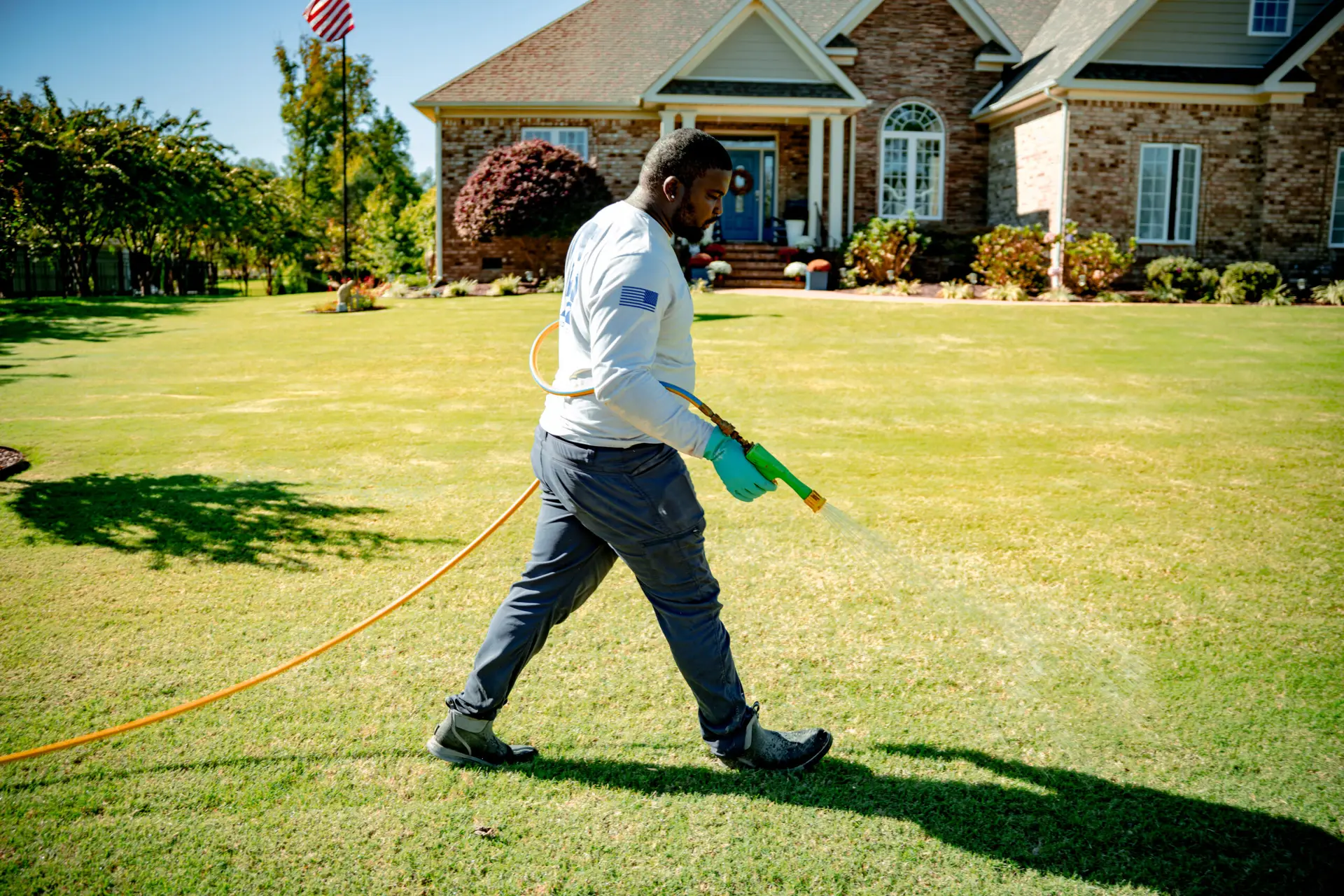
Active brown patch responds well to systemic fungicides labeled for the disease. Common active ingredients include azoxystrobin, propiconazole, myclobutanil, and triadimefon. Applications stop the spread within 7 to 10 days.
For homeowners, retail fungicides at home improvement and garden stores work when applied correctly. Read the label for the specific brown patch listing and follow application rates exactly.
Cost for professional application: $100 to $200 per visit on a typical residential lot.
Lawns with severe pressure may need 2 to 3 applications spaced 3 to 4 weeks apart. Lawns with light to moderate pressure typically need only one treatment per outbreak.
Cultural Changes That Reduce Pressure
Beyond fungicide, several cultural practices dramatically reduce brown patch development and recurrence.
Watering timing. Switch to early morning only (4 to 8 a.m.). Stop any evening watering. The single biggest factor in brown patch pressure is canopy moisture overnight.
Watering depth. Deep infrequent cycles dry the surface between waterings and reduce disease conditions. Daily light watering keeps the canopy continuously moist.
Mowing height. Cut at the upper end of the fescue range (3.5 to 4 inches) during disease pressure. Taller cuts improve air circulation at the soil surface.
Air circulation. Trim back overgrown shrubs that crowd the lawn perimeter. Open up sightlines around the property.
Nitrogen levels. Avoid heavy nitrogen during disease pressure. Excess nitrogen produces lush soft growth that is much more susceptible.
The Recovery Timeline
With treatment, here is what to expect.
Days 1 to 7: spread stops as the fungicide reaches the active fungal tissue. Patches stop expanding. Mycelium becomes less visible during morning observations.
Days 7 to 14: existing brown tissue remains dead. Surrounding healthy grass begins growing in. Visual change is minimal.
Weeks 2 to 4: surrounding fescue grows runners and tillers into the damaged areas. Density begins rebuilding. Color improves in patches.
Weeks 4 to 6: most patches mostly fill in. Some scarring may remain in heavily damaged areas. Full visual recovery for moderate damage.
Weeks 6 and beyond: complete recovery for light to moderate damage. Severe damage may require fall overseeding to fully rebuild density.
Preventive Programs for Recurring Properties
For lawns with brown patch every summer, preventive fungicide programs reduce annual damage. Apply the first preventive treatment in late May before night temperatures consistently hit 65 degrees. Second application 21 to 28 days later. Continue through August on a 21 to 28 day cycle. Stop when night temperatures drop in September.
Cost of preventive program: $400 to $700 per season for a typical residential lot. Compare to repeated active outbreaks each costing $300 to $500 plus the visual damage during the disease and recovery periods.
For most properties with confirmed brown patch history, the math favors prevention.
Long-Term Resistance Building
Several practices reduce annual brown patch pressure over multiple years.
Overseed with disease-resistant fescue varieties. Newer turf-type tall fescue cultivars (Rebel, Falcon, Bonsai series) have meaningfully better brown patch resistance than older varieties.
Improve soil drainage in low areas that stay wet. Core aeration plus topdressing reduces localized pressure.
Reduce shade where possible. Tree thinning to allow morning sun on shaded fescue areas reduces canopy moisture.
Build soil health. Lawns with 4 to 5 percent soil organic matter have meaningfully lower disease pressure than lawns with depleted soil.
What Brown Patch Often Gets Confused With
Drought stress: browns evenly across exposed areas, recovers with watering. Brown patch keeps spreading despite watering.
Take-all root rot: irregular patches where grass pulls up easily because roots are gone. Different fungal disease, different treatment.
Chinch bug damage: starts in hottest sunniest spots, soap flush test surfaces bugs.
Pet urine damage: small (1 to 2 feet) circular spots with dark green ring of nitrogen-boosted grass around them.
Irrigation gaps: predictable shapes matching coverage gaps, no mycelium present.
Why Some Fescue Lawns Get Brown Patch Every Year and Others Do Not
For homeowners wondering why their neighbor’s fescue lawn seems immune while theirs gets brown patch every year, several factors typically explain the difference. Drainage quality (well-drained soil reduces pressure). Shade and air circulation (open sunny areas have less pressure). Watering practices (morning vs evening makes a dramatic difference). Mowing height (taller cuts reduce pressure). Fertility timing (heavy spring nitrogen increases pressure). Variety mix (some cultivars are dramatically more resistant). The cumulative effect of these factors explains most of the difference between consistent-pressure lawns and rarely-affected lawns.
Frequently Asked Questions
How quickly do I need to treat once I confirm brown patch?
Within 3 to 7 days for best results. Earlier treatment limits damage. Late treatment stops spread but does not undo damage done.
Can I prevent brown patch entirely?
Not entirely. The fungus is present in our soils and conditions favor it every summer. You can dramatically reduce pressure but expecting zero brown patch is unrealistic in our climate.
Will my lawn fully recover this year?
For light to moderate damage, yes, within 4 to 8 weeks. Severe damage may require fall overseeding.
Do I need to replace my lawn with something more resistant?
Not necessarily. Most fescue lawns can be managed with proper practices. Switching to warm-season grass is an option for homeowners tired of fighting summer disease, but it is a significant project, not a small change.
What to Do Next
If you suspect brown patch on your fescue lawn, walk the lawn at dawn this week and look for mycelium. If confirmed, schedule treatment within a few days.
If you would rather have a professional confirm the diagnosis and handle the treatment, call us at 757-238-8901 or visit meadowlawnandpest.com. We serve Hampton Roads including Newport News, Norfolk, Virginia Beach, Chesapeake, Suffolk, Smithfield, Carrollton, Isle of Wight County, and surrounding communities.