
Short Answer: Hampton Roads is one of the most active tick environments on the East Coast because of our deer population, wooded edges, and long warm season. The diseases we deal with locally include Lyme, ehrlichiosis, anaplasmosis, Rocky Mountain spotted fever, and alpha-gal syndrome (a red meat allergy from lone star tick bites that has been rising sharply in Virginia). Ticks live in specific yard zones (shaded perimeter, wood lines, leaf litter, tall vegetation, around outbuildings) and effective prevention means treating those zones, not the whole lawn. Two professional applications a year combined with smart landscape habits typically reduces tick activity in your yard by 80 percent or more. Here is what every Hampton Roads homeowner should know before tick season hits its peak.
You let the dog out at dusk. Twenty minutes later you are picking a tick off her ear at the kitchen counter, then doing the full check, then washing your hands twice and wondering if you missed one. The kids were playing in the yard that afternoon. You make a mental note to check them at bath time. You think about the alpha-gal article you read last month and whether tonight should be a beef night.
If this scene is familiar, you are not paranoid. You are paying attention. Ticks in Hampton Roads have changed in the last ten years, and the playbook for keeping them off your family and your pets has changed with them.
So let us walk through what is actually happening, what is worth worrying about, and what works to keep ticks out of your yard.
Why Hampton Roads Is a Tick Hotspot
Several things stack on top of each other to make our region one of the most tick-active areas on the East Coast.
Our deer population is high and growing. Deer are the primary reproductive host for adult black-legged ticks (Lyme disease vector) and lone star ticks (alpha-gal vector). Hampton Roads has lost much of its rural deer habitat to development, but that has actually pushed deer into suburban and exurban yards rather than reducing their numbers. The result is more deer interacting with more residential properties than ever before.
Our landscape gives ticks ideal habitat. Mature neighborhoods across Hampton Roads feature wooded edges, leaf-littered borders, dense ornamental plantings, and that classic transition zone where mowed lawn meets unmowed underbrush. Ticks live in exactly that transition zone. They climb to the top of a blade of grass or a low leaf, extend their front legs (a behavior called questing), and wait for a warm-blooded host to brush past.
Our season is long and warm. Tick activity in our area runs from March through November, with peak nymph activity (the riskiest stage for human disease transmission) hitting hardest from May through July. Mild winters that do not produce sustained hard freezes allow tick populations to overwinter at higher numbers, which means each spring starts with more ticks than the year before.
Our humidity keeps them alive. Ticks dehydrate easily and need humid microclimates to survive. The leaf litter, ground cover, and shaded soil that defines so many Hampton Roads yards is essentially perfect tick lodging.
The Tick Species You Actually Encounter Here
Three species do most of the damage in our region, and they have different behaviors that matter for prevention.
The lone star tick is the most aggressive and the one most likely to bite humans in our area. Identifiable by the white spot on the back of adult females, lone stars actively pursue hosts rather than just waiting passively. They are the tick most associated with alpha-gal syndrome (a red meat allergy that develops after a bite, sometimes years later), and they also transmit ehrlichiosis and STARI (Southern Tick-Associated Rash Illness). Lone star ticks are active from April through August and are the most likely tick to find you during yard work.
The black-legged tick (also called the deer tick) is the Lyme disease vector. Smaller and harder to spot, especially in the nymph stage where it is the size of a poppy seed. Black-legged ticks are most active in spring (nymphs) and fall (adults), and they account for the majority of Lyme disease transmission. Lyme is established and growing in Virginia, with cases rising particularly in the Hampton Roads area.
The American dog tick is larger and more visible than the other two. It transmits Rocky Mountain spotted fever (a serious illness despite its name, which is misleading since most cases are actually east of the Rockies). Dog ticks are most active from April through July and are more often found on pets but readily bite humans.
Knowing which tick is on you matters because the treatment windows and disease risks are different. If you remove a tick and are not sure what species it was, save it in a sealed bag or pill bottle. Some testing services and health departments will identify it.
The Diseases We Are Actually Dealing With Locally
This section is uncomfortable to write because nobody wants to scare anybody. But the situation has changed enough that pretending nothing has changed does not serve you.
Lyme disease is now firmly established in Virginia and Hampton Roads. Cases have been climbing for two decades. Early symptoms include the classic bullseye rash (which only appears in about 70 percent of cases, so its absence does not rule Lyme out), fever, fatigue, and joint pain. Caught early, Lyme is treatable with antibiotics. Caught late, it can produce long-term joint, neurological, and cardiac symptoms that take years to resolve.
Alpha-gal syndrome is the change that most surprises people. A bite from a lone star tick can sensitize the immune system to a sugar molecule (alpha-gal) found in red meat. The result is a delayed allergic reaction (often 3 to 6 hours after eating beef, pork, or lamb) that can range from hives and stomach upset to full anaphylaxis. Alpha-gal cases in Virginia have risen sharply in recent years, and Hampton Roads is one of the higher-incidence areas in the state. The reaction can persist for years after the original bite.
Ehrlichiosis and anaplasmosis are tick-borne bacterial infections that produce flu-like symptoms (fever, headache, muscle aches) and can be serious if untreated. Both are present in our area.
Rocky Mountain spotted fever is rare but locally present and is one of the more serious tick-borne illnesses if not caught early.
For most healthy adults, a single tick bite still has low odds of causing illness. But the cumulative risk across a family that spends time outdoors all summer, multiplied by the rising tick populations, is high enough that prevention is no longer optional in our area.
Where Ticks Actually Live in Your Yard
This is the practical part. Ticks are not evenly distributed across your property. They live in specific zones, and knowing those zones changes everything about how you protect your family.
The high-tick zones in a typical Hampton Roads yard: the transition between mowed lawn and any wooded edge, leaf litter and ground cover under trees, dense ornamental plantings (especially shaded ones), the area around woodpiles and outbuildings, tall grass or unmowed sections, stone walls and the bases of fences, and any ground-level vegetation along walking paths.
The low-tick zones: the open mowed lawn itself, sun-exposed areas, paved patios and decks, and gravel paths.
This is why an effective tick treatment program does not spray the whole lawn. It targets the perimeter, the edges, the resting zones, and the transition areas where ticks actually live. A blanket lawn treatment wastes product on areas where ticks are not present anyway.
What Actually Works to Reduce Ticks in Your Yard
Combining a few habits with professional treatment dramatically reduces tick activity. Here is the playbook we recommend.
Create a tick barrier between lawn and woods. A 3-foot strip of wood chips, gravel, or hardscape between mowed grass and any wooded or unmaintained edge interrupts tick movement into the yard. Ticks do not like to cross dry, hot, hardscaped surfaces. This single change is one of the highest-leverage things you can do.
Keep grass mowed and leaf litter cleaned up. Tall grass holds humidity and shades soil, both of which ticks need. Regular mowing and seasonal leaf removal eliminates resting habitat. Pay particular attention to corners, fence lines, and the bases of trees.
Move play areas and seating away from yard edges. Where the kids play matters. A swing set or sandbox located 20 feet inside the lawn perimeter rather than against the wooded edge dramatically reduces exposure.
Manage deer access if possible. Deer-resistant landscaping near yard edges, fencing where appropriate, and removing food attractants reduces the deer pressure on your specific property. You cannot eliminate it, but you can reduce it.
Treat with a professional tick control program. A targeted barrier treatment applied to the high-risk zones in your yard, timed correctly through the season, can reduce tick populations by 80 to 90 percent. Two well-timed applications a year (one in late April or early May to catch the spring nymph emergence, one in mid-July for the summer adult population) provide most of the benefit. Properties with heavy pressure benefit from a third late-summer or early-fall application.
Treat your pets. Even a perfectly treated yard does not stop ticks from hitching a ride on neighborhood deer or carrying in on your dog from a walk. A veterinarian-prescribed tick prevention product is the most effective layer of defense for pets, and it also reduces what they bring back into the house.
What Does Not Work (or Barely Helps)
A few products and habits get marketed as tick solutions and consistently underperform.
Whole-yard sprays of off-the-shelf insecticide. Most consumer products are not formulated for tick biology, do not last, and waste product on low-tick zones. Some have shown limited effectiveness against fleas and mosquitoes but very little against established tick populations.
Tick tubes filled with permethrin-treated cotton (designed to kill ticks on mice). These have shown some effectiveness in academic studies but require sustained, multi-year use over a wide area to actually shift Lyme risk, and most homeowners cannot maintain that. As a single intervention, the impact is minor.
Essential-oil-based natural tick repellents. Cedar oil, garlic, peppermint and similar products have weak, short-lived effects that do not meaningfully reduce yard populations. Some can repel adult mosquitoes briefly but ticks are different physiologically and respond differently.
The “guinea fowl will eat all the ticks” idea. Guinea fowl do eat ticks but in numbers far below what is needed to control a yard population, and they create their own headaches as livestock. We mention this because we get the question.
How Our Tick and Flea Service Works
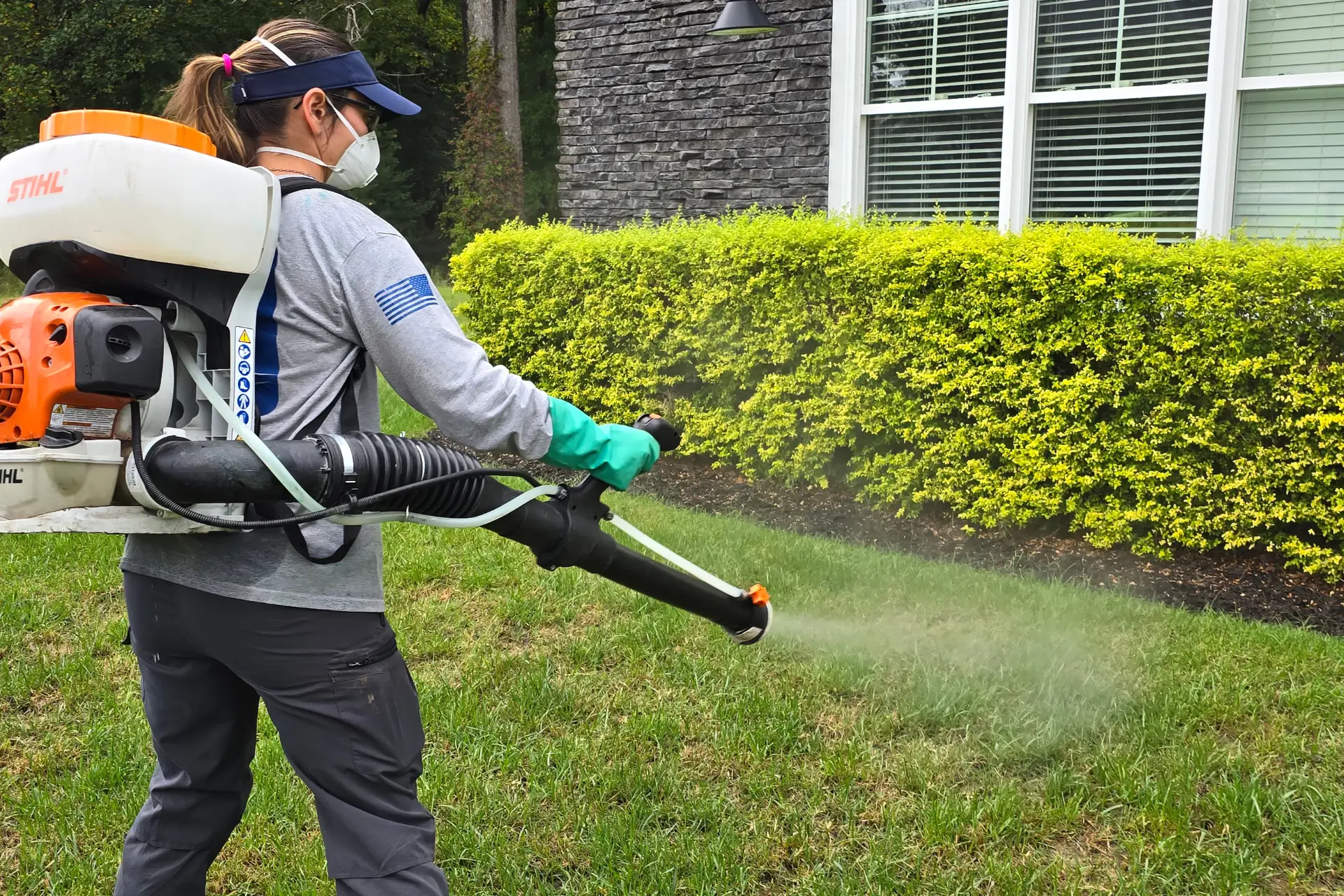
Our tick and flea program is a targeted barrier treatment applied to the specific yard zones where ticks live. We treat wooded edges, dense ground cover, fence lines, leaf-littered areas, the perimeter of outbuildings and playsets, and any other high-risk zones we identify when we walk your property.
We use products that are EPA-registered for residential tick and flea control, applied by licensed Virginia pesticide applicators, that dry within 30 to 60 minutes (after which the area is safe for kids and pets). Most properties get two applications per year (late spring and mid-summer) with the option of adding a third for properties with heavy pressure.
The service can be added to a Meadow lawn care program or stood up as a standalone service. Customers who add tick control alongside mosquito control typically get the best overall outdoor protection because the two services target different pests and different yard zones.
What to Do Next
If you would like tick control on your property this year, the timing question is easy: now. April is the right time to put your first treatment in place, before the spring nymph wave hits and before peak tick activity in May and June.
Call us at (757) 238-8901 or visit stg-5eq9zo.elementor.cloud/request-a-quote. We will walk your property, identify the high-risk zones specific to your layout, and put together a treatment plan with clear per-visit pricing. Most quotes go out within one business day, and you do not need to be home for treatments.
With 17+ years across Hampton Roads and a team that understands the specific tick pressures of coastal Virginia, Meadow Lawn and Pest is built to help you take your yard back from the things you cannot see until they are already on you. We proudly serve Carrollton, Smithfield, Windsor, Suffolk, Chesapeake, Hampton, Newport News, Poquoson, York County, and the surrounding area.
Whatever you decide, a few habit changes this weekend (mow the edges, clear leaf litter, move the play set 20 feet inward) will start protecting your family right away. The professional treatment side just makes the protection a lot more complete.