
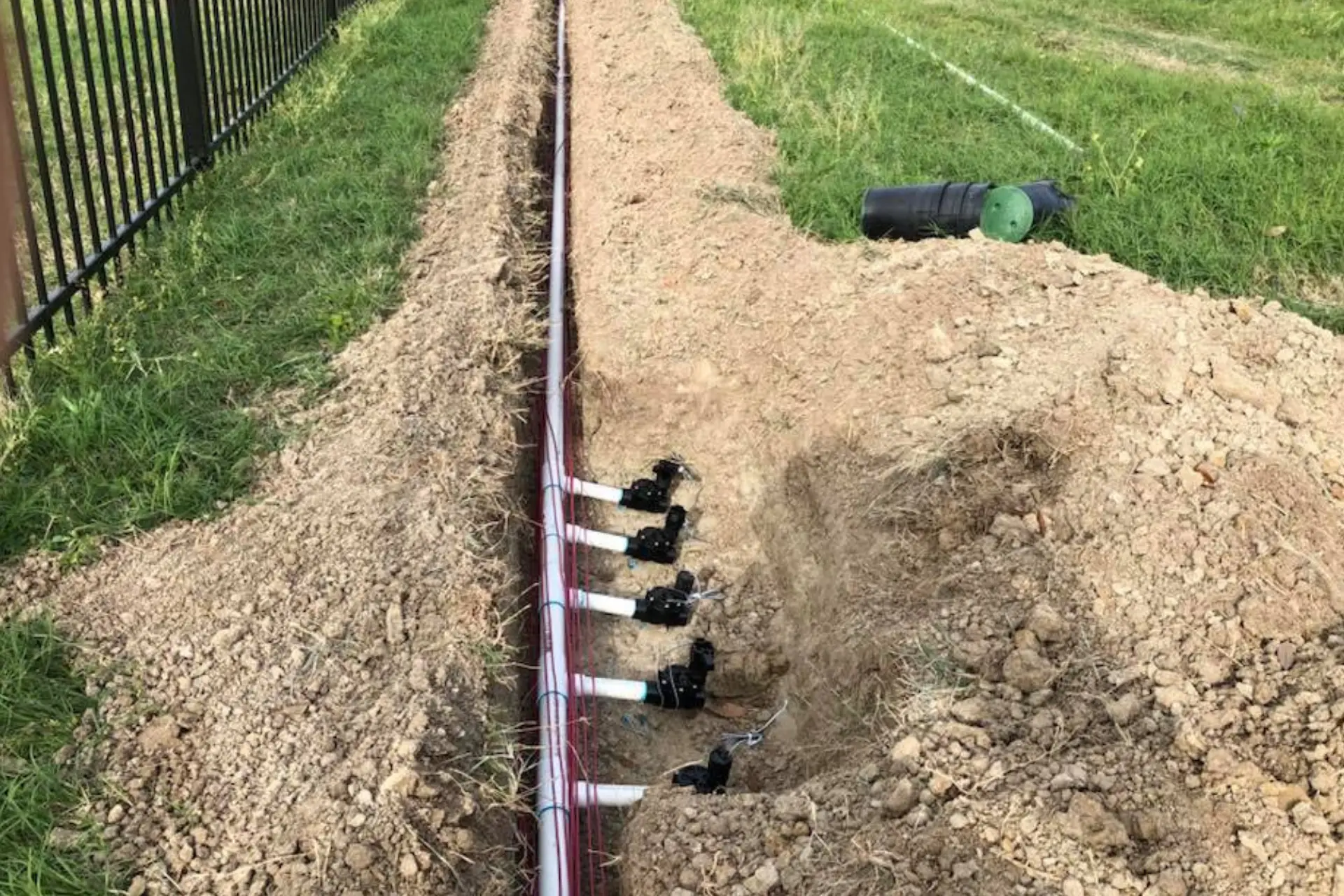
Short Answer: Most Hampton Roads irrigation systems are running 15 to 35 percent more water than they need to deliver a healthy lawn, and the homeowner is paying for every gallon of it. A proper May audit means turning each zone on while you stand at the heads, checking spray pattern, arc, throw distance, and pressure on every single head, measuring actual precipitation rate with a catch can test, and then comparing what your system delivers to what your grass actually needs in May (which is roughly 1 to 1.25 inches per week including rainfall). The math on a typical Hampton Roads home with a metered irrigation system can mean $20 to $60 per month of wasted water, and that is before you factor in the damage that overwatering does to the lawn itself.
May is the month when irrigation systems in Hampton Roads get turned back on for the season and run on whatever settings they happened to be on when they got shut off last October. Then the controller just keeps running that program until August, when somebody notices the lawn is suffering or the water bill jumped, and only then does anyone walk out to look at what the system is actually doing.
That is backward. May is exactly the right month to audit your irrigation, because the system is freshly active, the grass is growing, the weather is mild enough that you can stand outside for an hour and not melt, and any issues you find will save you money for the next five months.
Here is the full audit process we use on Hampton Roads properties, plus the math that should drive how much you spend on water.
Step One: Turn Each Zone On With You Standing Outside
The most common irrigation problem we find is that homeowners have never actually watched their own system run. They set the controller, they assume it works, and they only see the lawn results, not the spray pattern. So the first step in any audit is to start at zone one, turn it on at the controller for a few minutes, and walk through the area while it runs.
What you are looking for at each head: is the head popping up to its full height, or is it stuck partway? Is it rotating through its full arc, or is it jammed? Is the spray pattern clean, or is it fragmented? Are the nozzles clogged? Is the head tilted? Is the throw distance reaching where it should, or is it falling short and leaving a dry zone? Is the head spraying onto the driveway, the sidewalk, or the fence? Is there obvious leaking around the base when the head is up?
You will find issues on roughly 30 percent of heads in a typical Hampton Roads system that has not been audited in a few years. Clogged nozzles from sandy water, tilted heads from soil settling, blown seals around the base of pop-ups, and broken or missing nozzles are all extremely common.
Step Two: The Catch Can Test
To know how much water your system is actually applying, you cannot just rely on what the manufacturer says the head delivers. You have to measure it. The way we do this is with a catch can test, and you can do it yourself with cheap supplies.
Get 6 to 10 straight-sided containers (tuna cans work well, or rain gauges, or actually purpose-built catch cups if you want to be precise). Place them across one zone at varying distances from the heads. Run the zone for 15 minutes. Then use a ruler to measure how much water collected in each cup, in inches, and average the numbers.
Multiply that average by 4 to get inches per hour. That number is your precipitation rate. Most spray heads deliver 1 to 2 inches per hour in actual practice. Most rotary heads deliver 0.4 to 0.8 inches per hour. If your test produces something much higher or lower than expected, you probably have a head spacing or pressure issue.
Then check the distribution. If your catch cups range from 0.1 inch to 0.6 inch within the same zone, you have poor uniformity, which means the dry spots get nothing and the wet spots get drowned. Good distribution uniformity is roughly 70 to 80 percent across a zone. Below 50 percent, the system is fighting you.
Step Three: The Math on Water Cost
Most Hampton Roads homeowners have municipal water with sewer charges, and irrigation generally goes through a separate meter or gets credited differently depending on the locality. Pull your last water bill and look at the actual cost per 1,000 gallons (or sometimes per ccf, which is 748 gallons). In our service area, the all-in cost for residential water typically lands somewhere between $5 and $12 per 1,000 gallons depending on tier and locality.
Now do the math on your irrigation. A typical half-acre lawn covered by 4 zones running 30 minutes per zone, 3 days per week, with an average system flow of 12 gallons per minute, uses about 17,300 gallons per month. At $8 per 1,000 gallons (a representative blended rate), that is about $138 per month in May, June, July, August, and September. Across a five-month season, that is roughly $690 in water alone.
Now imagine that audit finds you are running 25 percent more water than needed. That is $170 over the season you are giving back to the water utility for no reason. And we routinely see homes overwatering by 35 to 50 percent.
Step Four: Dial in May Settings
In May, most Hampton Roads lawns need 1 to 1.25 inches of water per week including any rainfall. We get reasonable rainfall in May most years (often 3 to 4 inches across the month), which means your irrigation should be supplementing, not delivering, the full need.
The setup that works best for most properties is two longer watering events per week rather than three or four short ones. A longer watering event drives water deeper into the soil, which encourages deeper roots and a more drought-resistant lawn. Light frequent watering keeps roots near the surface and makes the lawn more vulnerable when summer heat arrives.
Time of day matters too. We want all irrigation done between roughly 3 AM and 8 AM. That timing minimizes evaporation, lets the canopy dry by mid-morning to reduce disease pressure, and gets the water to the roots when soil temperatures are coolest. Evening watering, which a lot of older systems are still set up to do, is the worst possible timing because it leaves the canopy wet through warm humid nights and feeds the brown patch and dollar spot we wrote about earlier this month.
What We Can Do for You
If the audit process sounds like a lot, that is because it is. The good news is we do this work for Hampton Roads homeowners regularly. A professional irrigation audit from us includes the head-by-head inspection, catch can testing across each zone, controller programming review, and a written report on what needs to change and what it will save you.
We can also coordinate with an irrigation repair specialist if you need new nozzles, head replacements, valve work, or pressure regulation parts installed. Audit, repair, and re-test is the cycle that turns a wasteful system into one that delivers exactly what your lawn needs for the lowest possible water bill.
Call (757) 238-8901 or request a quote at stg-5eq9zo.elementor.cloud/ to get on the schedule for a May or June audit. Your lawn will look better and your water bill will look smaller. Both of those things matter.
Water is one of the most expensive lawn inputs in coastal Virginia. Spending it intentionally is one of the best returns you can get on a single afternoon of work.